Language

PSY 511.001 Spr 2026

Rick Gilmore

Department of Psychology

Overview

Prelude

Figure 1: Bow (2022)1

Announcements

  • Final Project proposal due March 5, 2026.

Announcements

  • Thursday, February 19, 2026

Today’s topics

  • Language and the brain
  • Read & discuss
    • Bourguignon & Lo Bue (2025) or
    • Zada et al. (2025) or
    • ideas suggested in Google AI (2026)

Warm-up

Hebbian learning is like which common statistical measurement?

  • A. Mean
  • B. Median
  • C. Variance
  • D. Covariance

Hebbian learning is like which common statistical measurement?

  • A. Mean
  • B. Median
  • C. Variance
  • D. Covariance
  • Univariate
    • Mean, median, variance
  • Bivariate
    • Covariance
  • Multivariate
    • Matrix of covariances

What event(s) does the NMDA receptor respond to?

  • A. Cell A releases glutamate onto Cell B.
  • B. Cell B responds (fires an action potential).
  • C. Cell B releases glutamate onto Cell C.
  • D. A and B.
  • E. A and C.

What event(s) does the NMDA receptor respond to?

  • A. Cell A releases glutamate onto Cell B.
  • B. Cell B responds (fires an action potential).
  • C. Cell B releases glutamate onto Cell C.
  • D. A and B.
  • E. A and C.

Which of the following statements are incorrect?

  • A. Computer memory is designed to fade in time like biological memory.
  • B. Computer memory is separate from information processing.
  • C. Biological memory is integrated with information processing.
  • D. Memory in computers can be stored in networks that are similar to brains.

Which of the following statements are incorrect?

  • A. Computer memory is designed to fade in time like biological memory.
  • B. Computer memory is separate from information processing.
  • C. Biological memory is integrated with information processing.
  • D. Memory in computers can be stored in networks that are similar to brains.

Language and the brain

Integrative perspectives

  • Language as action
  • Language as perception
  • Language as cognition
    • Dependence on learning & memory

Language behavior

Figure 2: VideoCollectables (2014)

Components

  • Productive
    • Speaking (2-5 words/s), modulate prosody (intonation)
      • Often combined with gesture, facial expression, para- and non-linguistic sounds
    • Writing, typing (.5-3+ words/s), 200 wpm!
    • Morse code (25-50 wpm)

Components

  • Receptive
    • Listening
    • Responding (facial expressions, gestures, laughter, etc.)
    • Reading (3-5 words/s)
    • Morse code (30-50 wpm or 0.8+ word/s) (Zoglmann, 2025)
  • How so fast? Time for feedback?

Speech input/output

By Aquegg - Own work, Public Domain, https://commons.wikimedia.org/w/index.php?curid=5544473

By Aquegg - Own work, Public Domain, https://commons.wikimedia.org/w/index.php?curid=5544473

Cognitive components

  • Speech sounds \(\rightarrow\) words
    • ifyoudidnotknowtheenglishlanguagethiswould beanincomprehensiblestreamoflettersorsounds
    • Perceive stream, parse into component sequences
  • Words \(\rightarrow\) meaning(s)

Hierarchical structure

  • Phonetic
    • |Ber| |wiTH| |mē|

Hierarchical structure

  • Syntactic
    • Subject | Verb | Object
  • Semantic

Hierarchical structure

Wikipedia contributors (2025)

Wikipedia contributors (2025)2

Hierarchical structure

  • Pragmatic

Network components

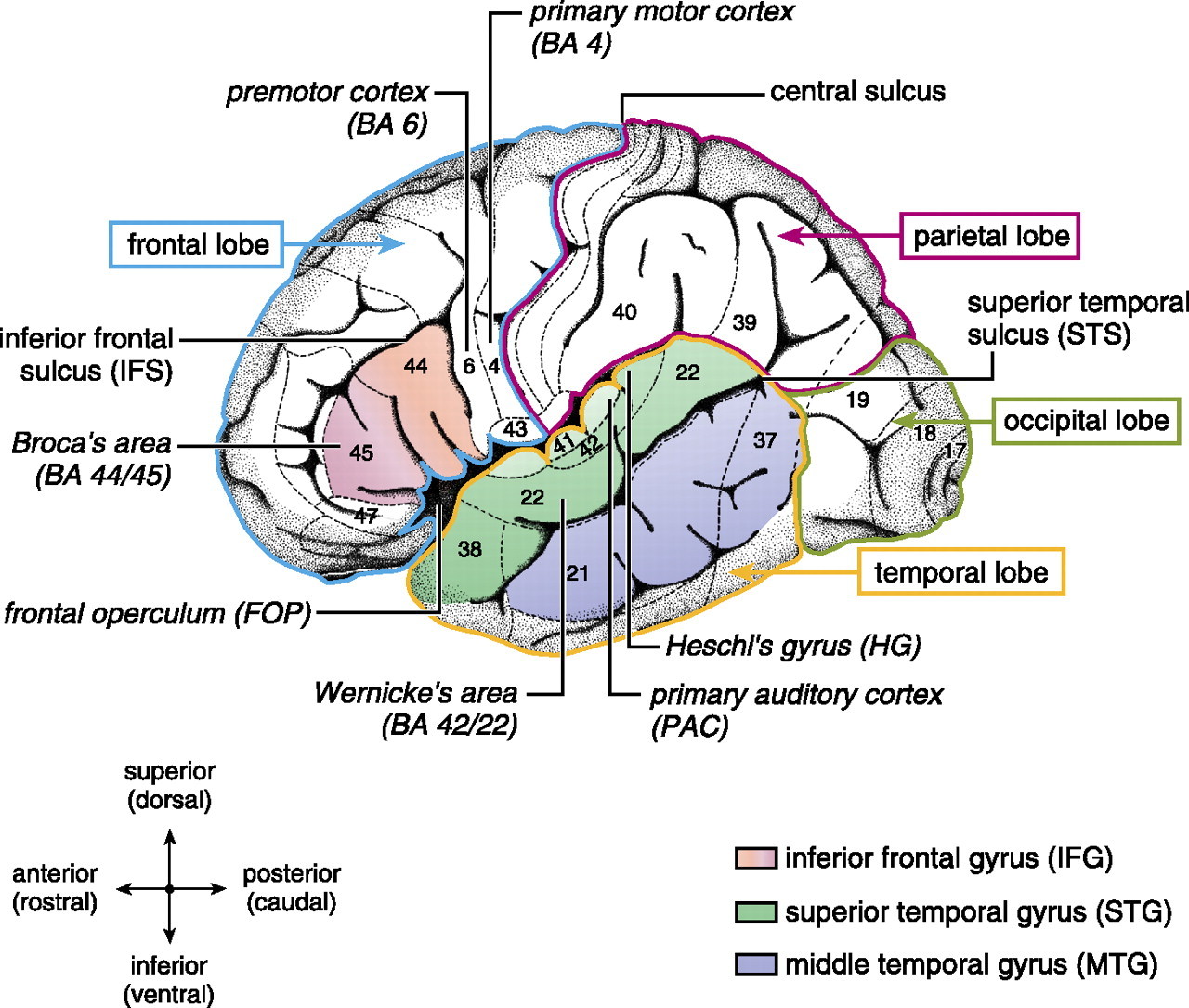
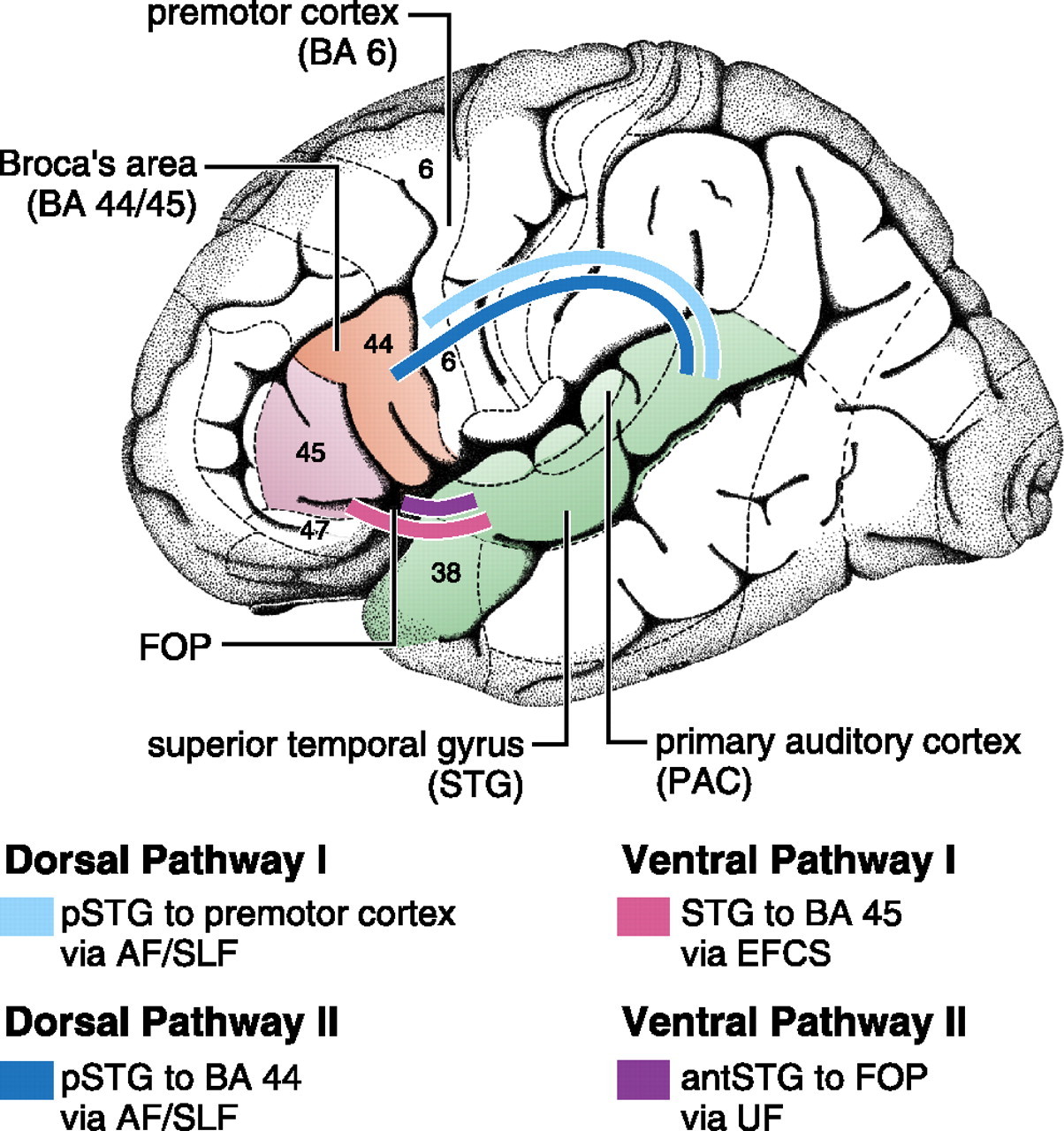
Friederici (2011) Figure 1

Friederici (2011) Figure 13

(Broca)-Wernicke-(Lichtheim)-Geschwind (WG) model

(Broca)-Wernicke-(Lichtheim)-Geschwind (WG) model

Tremblay & Dick (2016) Figure 1

Tremblay & Dick (2016) Figure 1

(Broca)-Wernicke-(Lichtheim)-Geschwind (WG) model

  • Speaking ≠ Writing/typing
  • Perception ≠ production

Wikipedia contributors (2023)

Wikipedia contributors (2023)

Input/output flow

flowchart LR
  A[speech input] --> B["Auditory Cortex (A1)"]
  H[text input] -->|eye movements| C["Visual Cortex (V1)"]
  B --> I["???"]
  C --> I
  I --> D[speech output]
  I --> F["typing/writing"]
  D --> M["Primary motor cortex (M1)"]
  F --> M
  M --> E["Vocal apparatus"]
  M --> G["Finger, wrist muscles"]
Figure 3: Minimal circuit diagram for verbal & visual language.

Wernicke’s area (Brodmann Area or BA 42)

  • Adjacent to primary auditory cortex (A1; Heschl’s gyrus; BA 41)
  • Perception
  • Receptive or ‘fluent’ aphasia

Wikipedia

Wikipedia

Wikipedia

Wikipedia5

Wikipedia

Wikipedia6

Figure 4: Illustration of Wernicke’s aphasia (cogmonaut, 2010)

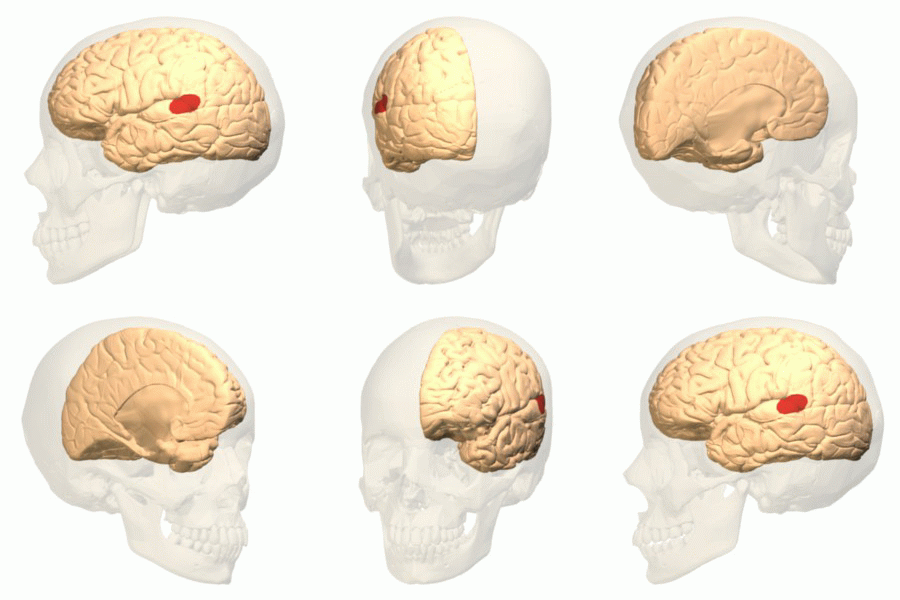
Broca’s area

  • Inferior frontal gyrus, pars opercularis (BA 44) & pars angularis (BA 45)
  • Production
  • Syntactic comprehension
  • Expressive aphasia

Wikipedia contributors (2026b)

Wikipedia contributors (2026b) 7

Wikipedia contributors (2026b)

Wikipedia contributors (2026b)8

Figure 5: Illustration of Broca’s aphasia (purepedantry, 2007)

Arcuate fasciculus9

  • Wikipedia contributors (2026c)
  • Connects Wernicke’s & Broca’s areas

Wikipedia contributors (2026c)

Wikipedia contributors (2026c)10

Tremblay & Dick (2016)

Tremblay & Dick (2016)
  • “No consistent definition of Broca’s and Wernicke’s areas”
  • “Beyond the arcuate fasciculus”
  • “We advocate for rejection of the Classic model and its terminology”

Because the simple architecture of the Classic Model suggests a language-centric perspective, the resilience of the model has perpetuated different flavors of the longstanding idea that the neural machinery for language is “special”, that is, the notion that there exists neural tissue dedicated to the specific task of processing and producing language.

Tremblay & Dick (2016)

An alternative view is that language is, at least in part, an overlaid functional system that “gets what service it can out of nervous tissues that have come into being and are maintained for very different ends than its own” (adapted from Sapir, 1921).

Tremblay & Dick (2016)

Dual streams?

  • Ventral (speech signals -> semantics)
  • Dorsal (speech signal acoustics -> articulatory networks in frontal lobe)
  • Hickok & Poeppel (2007)

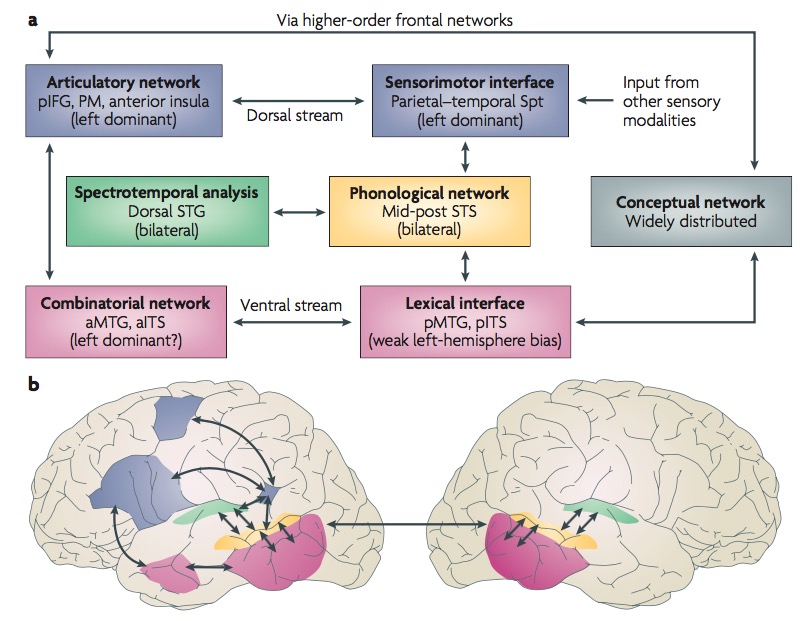
Hickok & Poeppel (2007) Figure 1

Hickok & Poeppel (2007) Figure 111

Wikipedia

Wikipedia12

Friederici (2011) Figure 3

Friederici (2011) Figure 313

Uncinate Fasciculus: Wikipedia

Uncinate Fasciculus: Wikipedia14

Extreme (Fiber) Capsule System: Wikipedia

Extreme (Fiber) Capsule System: Wikipedia15

Arcuate Fasciculus: Wikipedia

Arcuate Fasciculus: Wikipedia16

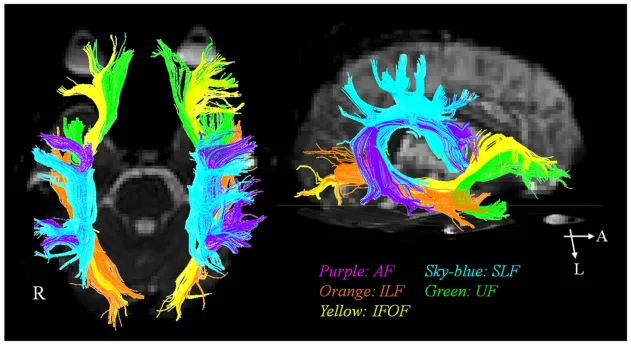
Jang (2013) Figure 1

Jang (2013) Figure 117

Dual streams hypothesis in vision

  • Wikipedia contributors (2026d)
  • Goodale & Milner (1992); Mishkin, Ungerleider, & Macko (1983)

Wikipedia

Wikipedia18

Metaanalytic evidence

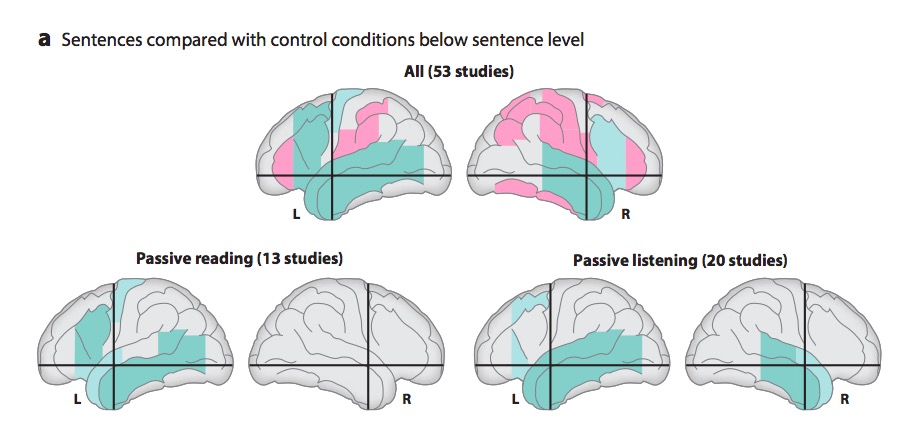
Hagoort & Indefrey (2014) Figure 1a

Hagoort & Indefrey (2014) Figure 1a19

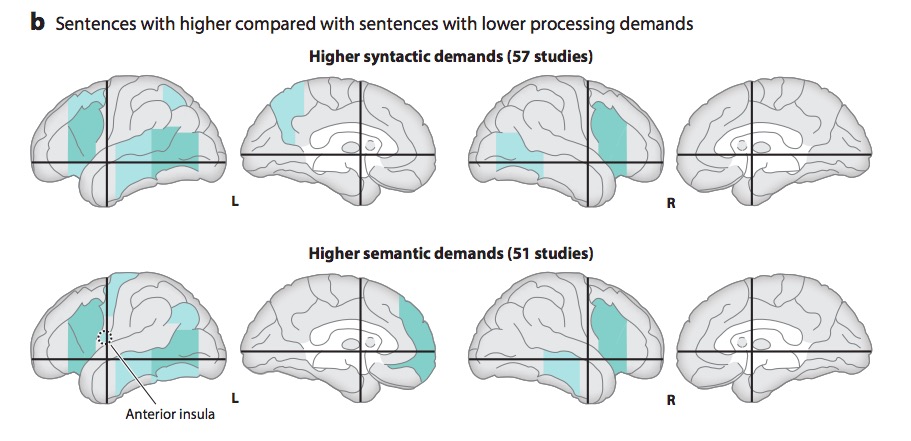
Hagoort & Indefrey (2014) Figure 1b

Hagoort & Indefrey (2014) Figure 1b

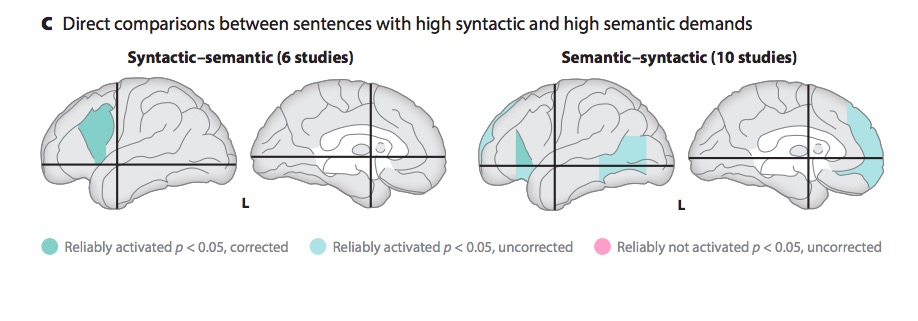
Hagoort & Indefrey (2014) Figure 1c

Hagoort & Indefrey (2014) Figure 1c

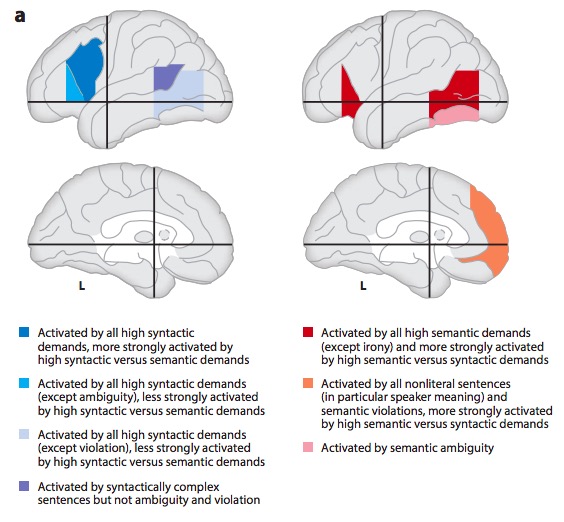
Hagoort & Indefrey (2014) Figure 2

Hagoort & Indefrey (2014) Figure 220

A meta-analysis of numerous neuroimaging studies reveals a clear dorsal/ventral gradient in both left inferior frontal cortex and left posterior temporal cortex, with dorsal foci for syntactic processing and ventral foci for semantic processing. In addition…further networks need to be recruited to realize language-driven communication to its full extent.

Hagoort & Indefrey (2014)

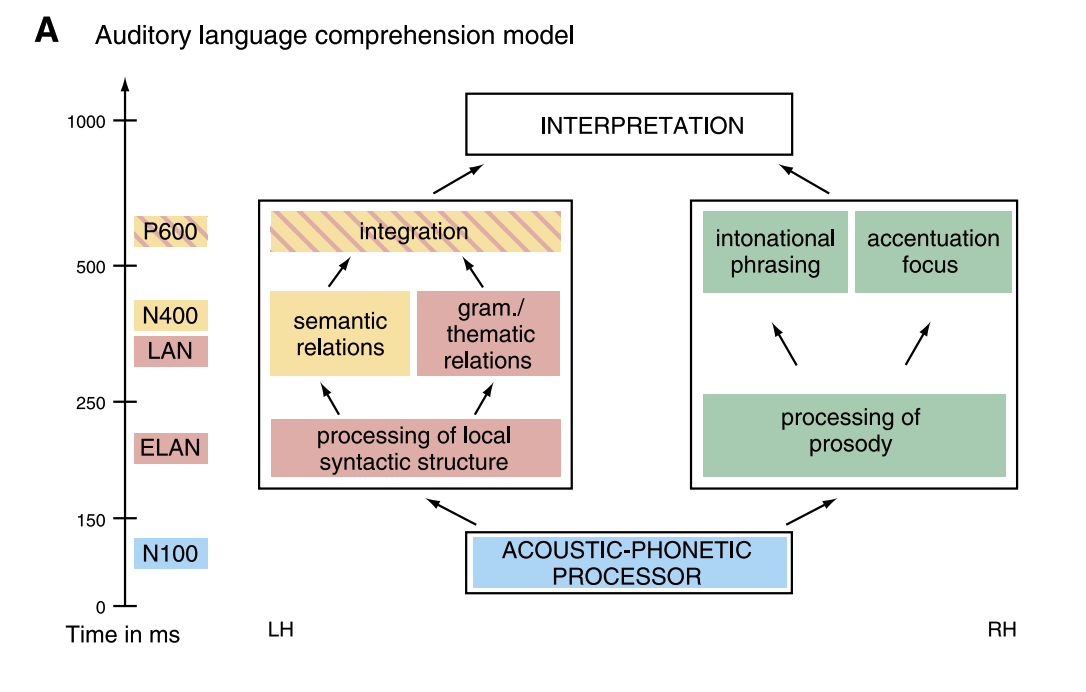
Friederici (2011) Figure 11a

Friederici (2011) Figure 11a

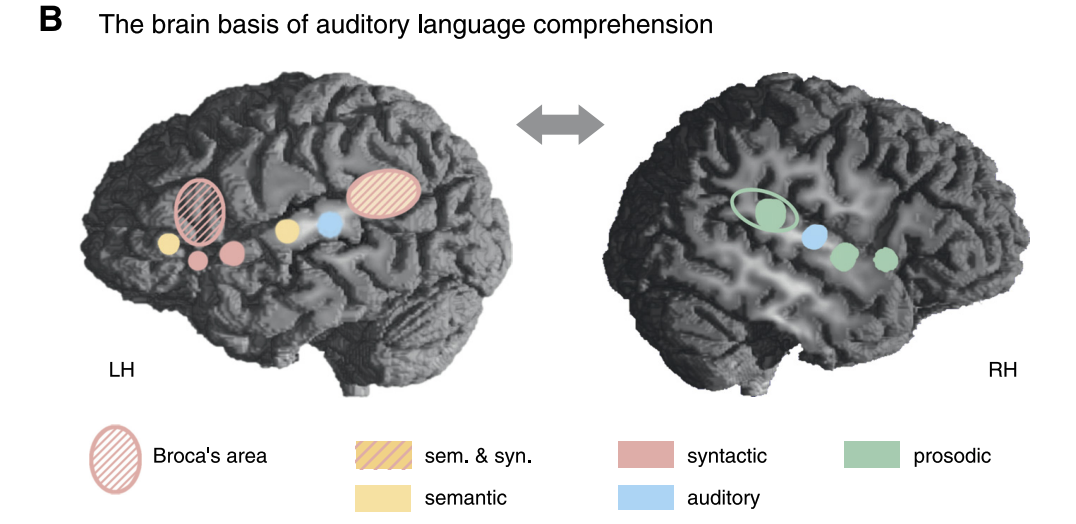
Friederici (2011) Figure 11b

Friederici (2011) Figure 11b

On system architectures

flowchart LR
  E[ ]:::empty
  W[ ]:::empty
  E --> A
  A[Perception] --> B[Cognition/Emotion]
  B --> C[Action]
  C --> W
  
  %% Define the style for the empty node
  classDef empty height:0,width:0,margin:0;
Figure 6: A simplistic feedforward psychological architecture.
flowchart LR
  E[ ]:::empty
  W[ ]:::empty
  E --> A
  A[Perception] --> B[Cognition]
  A --> C[Emotion]
  B --> D[Action]
  C --> D
  D --> W
  
  %% Define the style for the empty node
  classDef empty height:0,width:0,margin:0;
Figure 7: A barely more complicated feedforward & parallel psychological architecture.

On system architectures

flowchart LR
  E[ ]:::empty
  W[ ]:::empty
  E --> A
  A[Perception] <--> B[Cognition]
  A <--> C[Emotion]
  B & C <--> D[Action]
  D --> W
  
  %% Define the style for the empty node
  classDef empty height:0,width:0,margin:0;
Figure 8: A more realistic feedforward/feedback parallel architecture.
flowchart LR
  E[ ]:::empty
  W[ ]:::empty
  E --> A
  A[Perception] <--> B[Cognition]
  A <--> C[Emotion]
  B <--> C
  B & C <--> D[Action]
  D --> W
  
  %% Define the style for the empty node
  classDef empty height:0,width:0,margin:0;
Figure 9: An even more realistic feedforward/feedback parallel architecture.

On large language models (LLMs)

  • Wikipedia contributors (2026e)
  • AI systems trained to predict the next word or set of words (tokens)
  • Use deep (multi-, e.g., 100+ layer) neural network architecture
  • Gemini AI may have 1e12+ (trillions) of parameters
  • Each word in an LLM represented by a vector (often 2^12 or 4,096) of numbers (feature values) (Heaven, 2026)

“Why AI uses so much energy — and what we can do about it” (2025)

“Why AI uses so much energy — and what we can do about it” (2025)

By 2030-2035 data centers could account for 20% of global energy use…

“Why AI uses so much energy — and what we can do about it” (2025)

Read & discuss

Options

  • Bourguignon & Lo Bue (2025) or
  • Zada et al. (2025) or
  • ideas suggested in Google AI (2026)

Wrap-up

Main points

  • Language behavior engages multiple sensory and motor systems working in parallel.
  • Earlier and simpler input/output models have yielded to more complex parallel and interactive network models.
  • Comprehending and producing language engages multiple regions of the brain.
  • Some functions are lateralized, especially in the left hemisphere.

Our human heritage

<iframe width=“1200 height=”450” src=“https://www.youtube.com/embed/IgmB9c29UKU?si=aSViHzbK0w6Za49u” title=“YouTube video player” frameborder=“0” allow=“accelerometer; autoplay; clipboard-write; encrypted-media; gyroscope; picture-in-picture; web-share” referrerpolicy=“strict-origin-when-cross-origin” allowfullscreen>

Figure 10: BuzzFeedVideo (2019)

Next time

  • Emotion

Resources

About

This talk was produced using Quarto, using the RStudio Integrated Development Environment (IDE), version 2026.1.0.392.

The source files are in R and R Markdown, then rendered to HTML using the revealJS framework. The HTML slides are hosted in a GitHub repo and served by GitHub pages: https://psu-psychology.github.io/psy-511-scan-fdns-2026-spring/

References

Bourguignon, N., & Lo Bue, S. (2025). An emergentist account of language in the brain-seeking neural synergies behind human uniqueness. Journal of Cognitive Neuroscience, 37, 1717–1734. https://doi.org/10.1162/jocn_a_02331
Bow, J. (2022). Adriano Celentano - ’Prisencolinensinainciusol’. YouTube. Retrieved from https://www.youtube.com/watch?v=RObuKTeHoxo
BuzzFeedVideo. (2019). Deaf people answer commonly googled questions about being deaf. YouTube. Retrieved from https://www.youtube.com/watch?v=IgmB9c29UKU
cogmonaut. (2010). Wernicke’s aphasia. YouTube. Retrieved from https://www.youtube.com/watch?v=dKTdMV6cOZw&t=1s
Friederici, A. D. (2011). The brain basis of language processing: From structure to function. Physiological Reviews, 91, 1357–1392. https://doi.org/10.1152/physrev.00006.2011
Goodale, M. A., & Milner, A. D. (1992). Separate visual pathways for perception and action. Trends in Neurosciences, 15, 20–25. https://doi.org/10.1016/0166-2236(92)90344-8
Google AI. (2026, February 17). Graduate neuroscience of language topics. Retrieved February 17, 2026, from https://gemini.google.com/share/acb3f4f000e3
Hagoort, P., & Indefrey, P. (2014). The neurobiology of language beyond single words. Annu. Rev. Neurosci., 37, 347–362. https://doi.org/10.1146/annurev-neuro-071013-013847
Heaven, W. D. (2026, January 7). LLMs contain a LOT of parameters. But what’s a parameter? Retrieved February 18, 2026, from https://www.technologyreview.com/2026/01/07/1130795/what-even-is-a-parameter/
Hickok, G., & Poeppel, D. (2007). The cortical organization of speech processing. Nat. Rev. Neurosci., 8(5), 393–402. https://doi.org/10.1038/nrn2113
Jang, S. H. (2013). Diffusion tensor imaging studies on arcuate fasciculus in stroke patients: A review. Frontiers in Human Neuroscience, 7, 749. https://doi.org/10.3389/fnhum.2013.00749
Mishkin, M., Ungerleider, L. G., & Macko, K. A. (1983). Object vision and spatial vision: Two cortical pathways. Trends in Neurosciences, 6, 414–417. https://doi.org/10.1016/0166-2236(83)90190-x
purepedantry. (2007). Broca’s aphasia. YouTube. Retrieved from https://www.youtube.com/watch?v=f2IiMEbMnPM
Tremblay, P., & Dick, A. S. (2016). Broca and Wernicke are dead, or moving past the classic model of language neurobiology. Brain and Language, 162, 60–71. https://doi.org/10.1016/j.bandl.2016.08.004
VideoCollectables. (2014). World’s fastest talking man sings michael jackson’s BAD in 20 seconds @VideoScrapbookOfOurTimes. YouTube. Retrieved from https://www.youtube.com/watch?v=4X4Fy8YqysY
Why AI uses so much energy — and what we can do about it. (2025, April 8). Retrieved February 18, 2026, from https://iee.psu.edu/news/blog/why-ai-uses-so-much-energy-and-what-we-can-do-about-it
Wikipedia contributors. (2023, September 11). Wernicke–Geschwind model. Retrieved from https://en.wikipedia.org/wiki/Wernicke%E2%80%93Geschwind_model
Wikipedia contributors. (2025, November 12). Parse tree. Retrieved from https://en.wikipedia.org/wiki/Parse_tree
Wikipedia contributors. (2026a, January 11). Articulatory phonetics. Retrieved from https://en.wikipedia.org/wiki/Articulatory_phonetics
Wikipedia contributors. (2026b, January 26). Broca’s area. Retrieved from https://en.wikipedia.org/wiki/Broca%27s_area
Wikipedia contributors. (2026c, January 30). Arcuate fasciculus. Retrieved from https://en.wikipedia.org/wiki/Arcuate_fasciculus
Wikipedia contributors. (2026d, February 13). Two-streams hypothesis. Retrieved from https://en.wikipedia.org/wiki/Two-streams_hypothesis
Wikipedia contributors. (2026e, February 17). Large language model. Retrieved from https://en.wikipedia.org/wiki/Large_language_model
Zada, Z., Nastase, S. A., Speer, S., Mwilambwe-Tshilobo, L., Tsoi, L., Burns, S. M., … Tamir, D. I. (2025). Linguistic coupling between neural systems for speech production and comprehension during real-time dyadic conversations. Neuron, 0. https://doi.org/10.1016/j.neuron.2025.11.004
Zoglmann, K. (2025). Sentences containing common eight-word phrases - 50wpm. YouTube. Retrieved from https://www.youtube.com/watch?v=D9xmpwZW2UI
Footnotes

  1. https://en.wikipedia.org/wiki/Prisencolinensinainciusol

  2. By Traced by Stannered - Own work based on: ParseTree.jpg, Public Domain, https://commons.wikimedia.org/w/index.php?curid=1925920

  3. FIGURE 1. Anatomical and cytoarchitectonic details of the left hemisphere. The different lobes (frontal, temporal, parietal, occipital) are marked by colored borders. Major language relevant gyri (IFG, STG, MTG) are color coded. Numbers indicate language-relevant Brodmann Areas (BA) which Brodmann (1909) defined on the basis of cytoarchitectonic characteristics. The coordinate labels superior/inferior indicate the position of the gyrus within a lobe (e.g., superior temporal gyrus) or within a BA (e.g., superior BA 44; the superior/inferior dimension is also labeled dorsal/ventral). The coordinate labels anterior/posterior indicate the position within a gyrus (e.g., anterior superior temporal gyrus; the anterior/posterior dimension is also labeled rostral/caudal). Broca’s area consists of the pars opercularis (BA 44) and the pars triangularis (BA 45). Located anterior to Broca’s area is the pars orbitalis (BA 47). The frontal operculum (FOP) is located ventrally and more medially to BA 44, BA 45. The premotor cortex is located in BA 6. Wernicke’s area is defined as BA 42 and BA 22. The primary auditory cortex (PAC) and Heschl’s gyrus (HG) are located in a lateral to medial orientation.

  4. “Fig. 1. Left: The original model from Wernicke, 1874. For unknown reasons, the model is represented on the right hemisphere. Right: An update of the Classic model from Geschwind, 1972. In this figure, according to most anatomical definitions, the superior temporal gyrus is inadvertently mislabeled as the angular gyrus.”

  5. Talbot K, Louneva N, Cohen JW, Kazi H, Blake DJ, et al. (2011) Synaptic Dysbindin-1 Reductions in Schizophrenia Occur in an Isoform-Specific Manner Indicating Their Subsynaptic Location. PLoS ONE 6(3): e16886. doi:10.1371/journal.pone.0016886

  6. By Brodamnn - Brodmann (1909) File:Brodmann areas inside of lateral sulcus close up.png, Public Domain, https://commons.wikimedia.org/w/index.php?curid=20696476

  7. By Fatemeh Geranmayeh, Sonia L. E. Brownsett, Richard J. S. Wise - “Task-induced brain activity in aphasic stroke patients: what is driving recovery?” Fatemeh Geranmayeh, Sonia L. E. Brownsett, Richard J. S. Wise. Brain 2014 Oct 28;137(Pt 10):2632-48. Epub 2014 Jun 28. DOI: https://dx.doi.org/10.1093/brain/awu163, CC BY 3.0, https://commons.wikimedia.org/w/index.php?curid=38174526

  8. By Polygon data were generated by Database Center for Life Science(DBCLS)[2]. - Polygon data are from BodyParts3D[1], CC BY-SA 2.1 jp, https://commons.wikimedia.org/w/index.php?curid=32508617

  9. bundle of nerve fibers

  10. “By Yeh, F. C., Panesar, S., Fernandes, D., Meola, A., Yoshino, M., Fernandez-Miranda, J. C., … & Verstynen, T. (2018). Population-averaged atlas of the macroscale human structural connectome and its network topology. NeuroImage, 178, 57-68. - http://brain.labsolver.org, CC BY-SA 4.0, https://commons.wikimedia.org/w/index.php?curid=78299333”

  11. a | Schematic diagram of the dual-stream model. The earliest stage of cortical speech processing involves some form of spectrotemporal analysis, which is carried out in auditory cortices bilaterally in the supratemporal plane. These spectrotemporal computations appear to differ between the two hemispheres. Phonological-level processing and representation involves the middle to posterior portions of the superior temporal sulcus (STS) bilaterally, although there may be a weak left-hemisphere bias at this level of processing. Subsequently, the system diverges into two broad streams, a dorsal pathway (blue) that maps sensory or phonological representations onto articulatory motor representations, and a ventral pathway (pink) that maps sensory or phonological representations onto lexical conceptual representations. b | Approximate anatomical locations of the dual-stream model components, specified as precisely as available evidence allows. Regions shaded green depict areas on the dorsal surface of the superior temporal gyrus (STG) that are proposed to be involved in spectrotemporal analysis. Regions shaded yellow in the posterior half of the STS are implicated in phonological-level processes. Regions shaded pink represent the ventral stream, which is bilaterally organized with a weak left-hemisphere bias. The more posterior regions of the ventral stream, posterior middle and inferior portions of the temporal lobes correspond to the lexical interface, which links phonological and semantic information, whereas the more anterior locations correspond to the proposed combinatorial network. Regions shaded blue represent the dorsal stream, which is strongly left dominant. The posterior region of the dorsal stream corresponds to an area in the Sylvian fissure at the parietotemporal boundary (area Spt), which is proposed to be a sensorimotor interface, whereas the more anterior locations in the frontal lobe, probably involving Broca’s region and a more dorsal premotor site, correspond to portions of the articulatory network. aITS, anterior inferior temporal sulcus; aMTG, anterior middle temporal gyrus; pIFG, posterior inferior frontal gyrus; PM, premotor cortex.

  12. By Leathalperisthecoolest123321 - Own work, CC BY-SA 4.0, https://commons.wikimedia.org/w/index.php?curid=45449677

  13. FIGURE 3. Structural connectivities between the language cortices. Schematic view of two dorsal pathways and two ventral pathways. Dorsal pathway I connects the superior temporal gyrus (STG) to the premotor cortex via the arcuate fascile (AF) and the superior longitudinal fascicle (SLF). Dorsal pathway II connects the STG to BA 44 via the AF/SLF. Ventral pathway I connects BA 45 and the temporal cortex via the extreme fiber capsule system (EFCS). Ventral pathway II connects the frontal operculum (FOP) and the anterior temporal STG/STS via the uncinate fascile (UF).

  14. By Tractography data: Yeh, F. C., Panesar, S., Fernandes, D., Meola, A., Yoshino, M., Fernandez-Miranda, J. C., … & Verstynen, T. (2018). Population-averaged atlas of the macroscale human structural connectome and its network topology. NeuroImage, 178, 57-68. PubMed: https://www.ncbi.nlm.nih.gov/pmc/articles/PMC6921501/Skull and brain data: Nobutaka Mitsuhashi, Kaori Fujieda, Takuro Tamura, Shoko Kawamoto, Toshihisa Takagi, and Kousaku Okubo. (2009) BodyParts3D: 3D structure database for anatomical concepts. Nucleic Acids Research, Vol. 37, Database issue D782-D785, https://doi.org/10.1093/nar/gkn613 - Tractography data: http://brain.labsolver.org/diffusion-mri-templates/tractographySkull and brain data: http://lifesciencedb.jp/bp3d/, CC BY-SA 4.0, https://commons.wikimedia.org/w/index.php?curid=105038802

  15. By Yeh, F. C., Panesar, S., Fernandes, D., Meola, A., Yoshino, M., Fernandez-Miranda, J. C., … & Verstynen, T. (2018). Population-averaged atlas of the macroscale human structural connectome and its network topology. NeuroImage, 178, 57-68. - http://brain.labsolver.org/, CC BY-SA 4.0, https://commons.wikimedia.org/w/index.php?curid=78298710

  16. By Yeh, F. C., Panesar, S., Fernandes, D., Meola, A., Yoshino, M., Fernandez-Miranda, J. C., … & Verstynen, T. (2018). Population-averaged atlas of the macroscale human structural connectome and its network topology. NeuroImage, 178, 57-68. - http://brain.labsolver.org, CC BY-SA 4.0, https://commons.wikimedia.org/w/index.php?curid=78299333

  17. The diffusion tensor tractographies of neural tracts for language: the arcuate fasciculus (AF), the superior longitudinal fasciculus (SLF), the inferior longitudinal fasciculus (ILF), the uncinate fasciculus (UF), and inferior fronto-occipital fasciculus (IFOF).

  18. By Selket - I (Selket) made this from File:Gray728.svg, CC BY-SA 3.0, https://commons.wikimedia.org/w/index.php?curid=1679336

  19. Figure 1. Schematic representation of the brain showing regions with reliably reported activations for sentences compared with nonsentential stimuli (a) and sentences with high syntactic or semantic processing demands compared with simpler sentences (b,c). The left posterior inferior frontal gyrus is further subdivided into Brodmann areas (BA) 44 (above black line), BA 45 (below black line, above AC–PC line) and BA 47 (below AC–PC line). Green regions indicate a reliable number of reports. Pink regions indicate no reports in 53 studies. For details, see Supplemental Tables 2, 3, and 4. Abbreviations: AC, anterior commissure; PC, posterior commissure).

  20. (a) Summary of activation patterns for sentences with high syntactic or semantic processing demands compared with simpler sentences. (b) Syntactic/semantic gradients in left inferior frontal and posterior temporal cortex based on 28 studies reporting posterior temporal cortex activation for syntactically demanding or semantically demanding sentences compared with less demanding sentences (see Supplemental Figure 13 for details). The centers represent the mean coordinates of the local maxima, and the radii represent the standard deviations of the distance between the local maxima and their means. Abbreviations: GFm, GFi, middle and inferior frontal gyri; BA, Brodmann area; GTs, GTm, GTi, superior, middle, and inferior temporal gyri; STS, ITS, superior and inferior temporal sulci; Gsm, supramarginal gyrus.