Somatosensation

2025-11-18

Rick Gilmore

Department of Psychology

Prelude

Ross-Topic (2018)

ThePoliceVEVO (2010)

Announcements

  • Exam 3 on Tuesday, December 2, 2025

Today’s topics

  • Warm up
  • Somatosensation
  • Pain

Warm up

Somatosensation

What is it?

  • Sensations about the body (soma)

Types of somatosensation

  • Internal (interoceptive)
    • How do I feel?
    • Where/how is my body positioned?
    • Proprioception (perception of the self)
  • External (exteroceptive)
    • What’s in the world?
    • Where is it?

Internal senses

  • Kinesthesia
    • Body position
    • Movement
  • Vestibular sense
    • Head position (relative to gravity)
    • Head movement (rotation, translation)

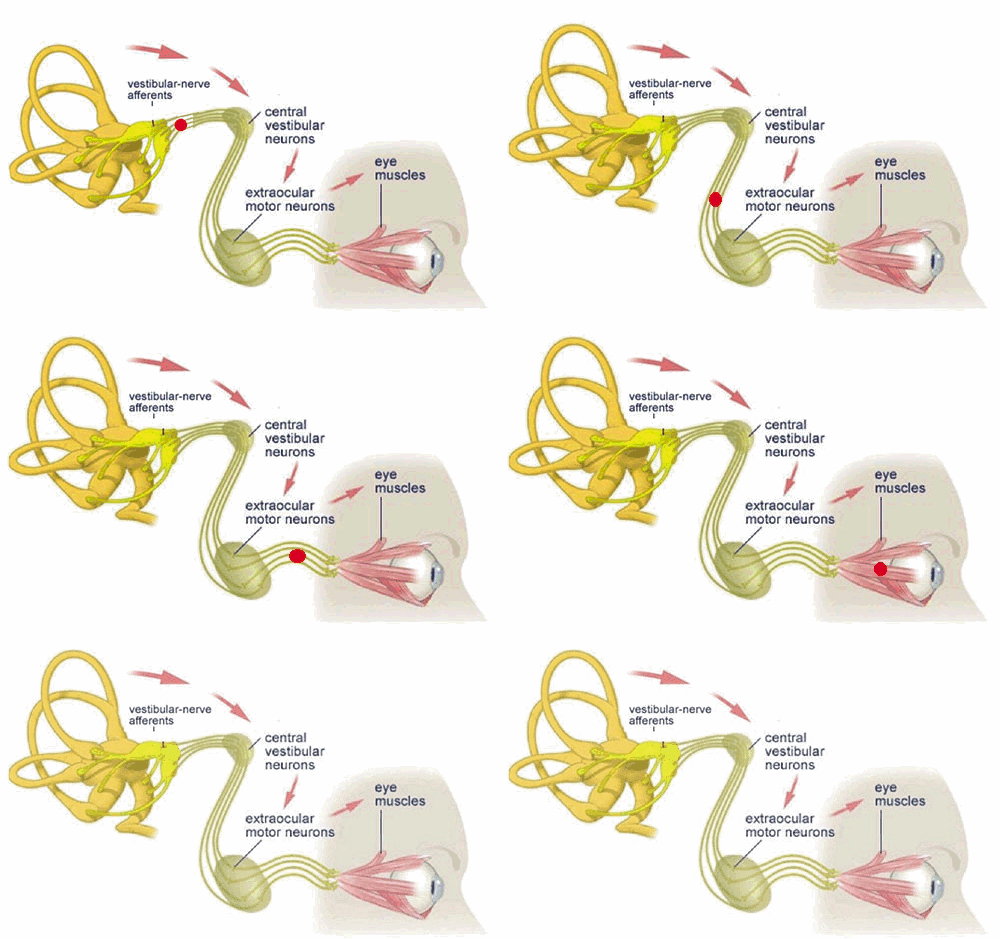
Vesibulo-ocular response (VOR)

  • Keeps eyes steady when head moves
  • Fast: response < 10 ms
  • Disturbed in vertigo

Vestibulo-ocular response (VOR): https://www.mcgill.ca/vestibular-gazecontrol-lab/files/vestibular-gazecontrol-lab/images/222_0.gif

Vestibulo-ocular response (VOR)

  • Keeps eyes steady when head moves
  • Can’t walk & text without it

Castilla (2007)

External senses

  • What’s out there and where is it located?
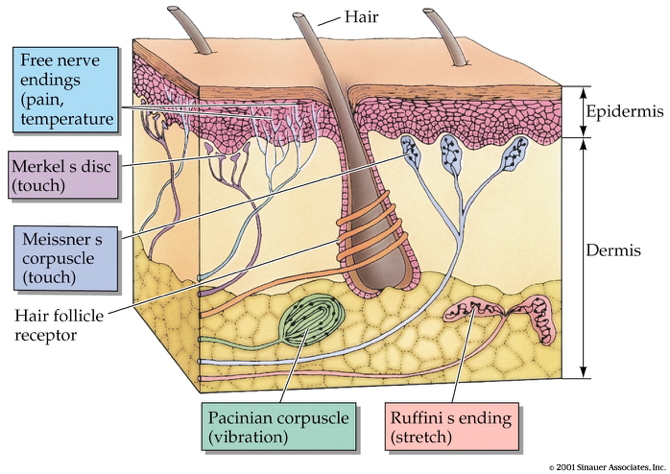
  • Cutaneous (receptors in the skin) senses
    • Hot, cold
    • Pressure
    • Vibration
  • Plus kinesthesia (why?)

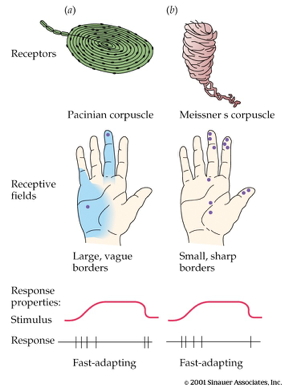
Cutaneous receptors

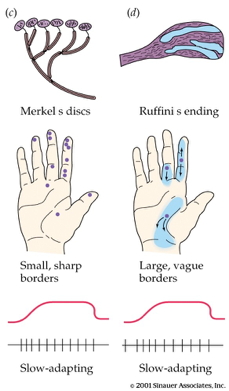
  • Receptors specialize in different info types, properties
Question

  • Why are minty foods cool?
  • Why are spicy foods hot?

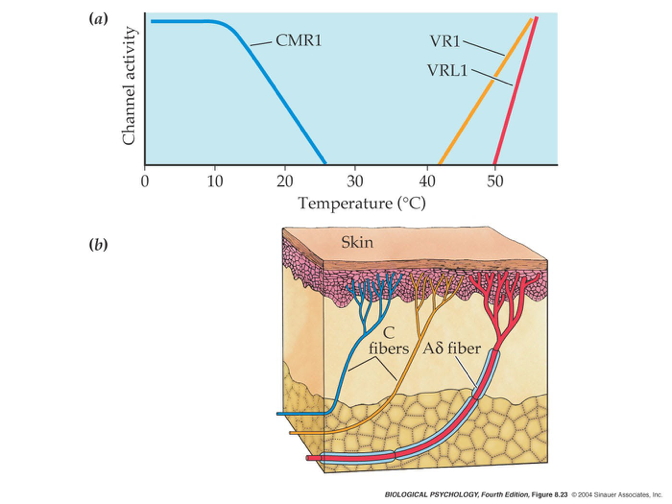
Receptors detect chemicals + temperature

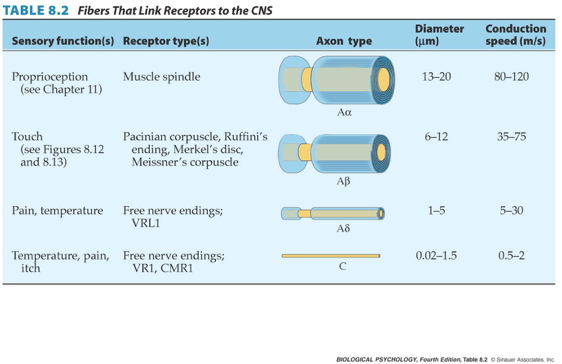
  • Menthol/mint receptor (CMR1)
    • Also signals “cool” temperatures

Receptors detect chemicals + temperature

  • Vanilloid Receptors (TrpV1/VR1, VRL1)
    • Respond to capsaicin (in peppers), allyl isothiocyanate (in mustard, wasabi)
    • Also signal “hot” temperatures

Axon size/speed trade-off

  • Not all info travels at the same speed
  • Thicker -> faster
  • Myelinated -> faster

Axon size/speed trade-off

  • Fast: Kinesthesia (from muscles and joints) the fastest
  • Slow: Pain/itch, temperature

From skin to brain

  • Cutaneous receptors ->
  • Dorsal root ganglion in spinal cord ->
  • Ventral posterior lateral (VPL) thalamus ->
  • Primary somatosensory cortex (S1) ->
    • Post-central gyrus of parietal lobe

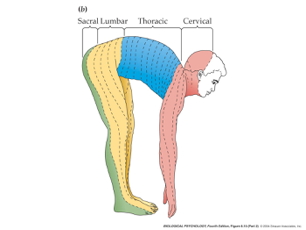
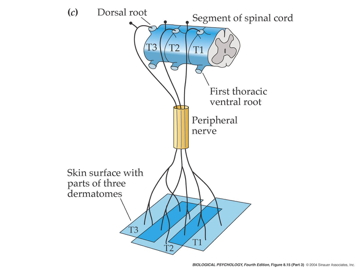
Dermatomes

  • Patches of skin ennervated by a set of nerves
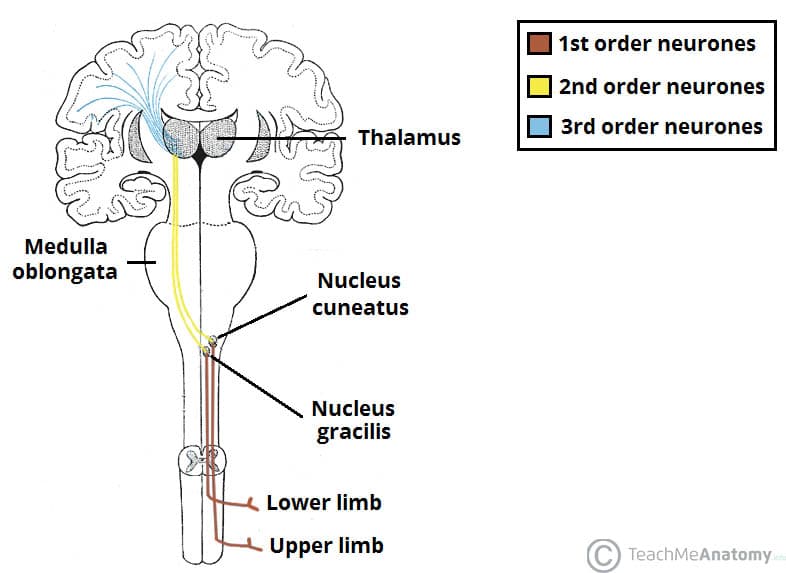
Functional segregation in spinal cord

  • Separate pathways for different information types
  • Dorsal column/medial leminiscal pathway
    • Touch, proprioception

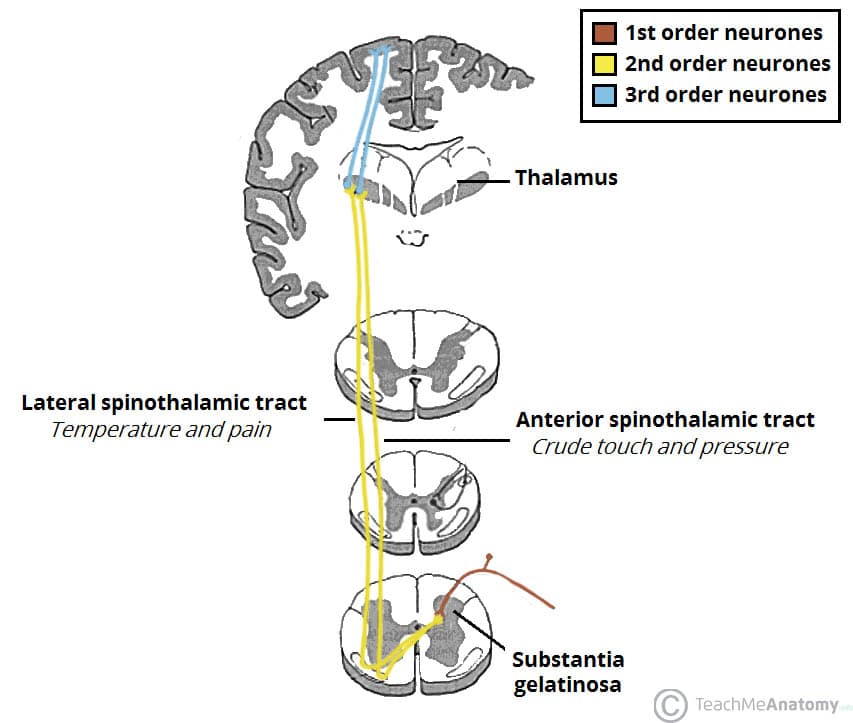
Functional segregation in spinal cord

  • Spinothalamic tract
    • Pain, temperature

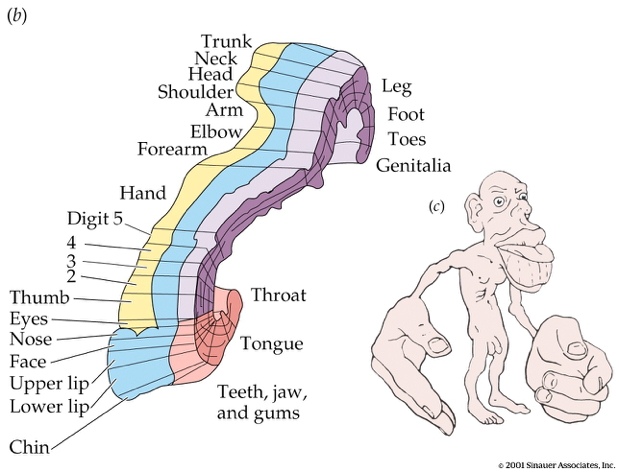
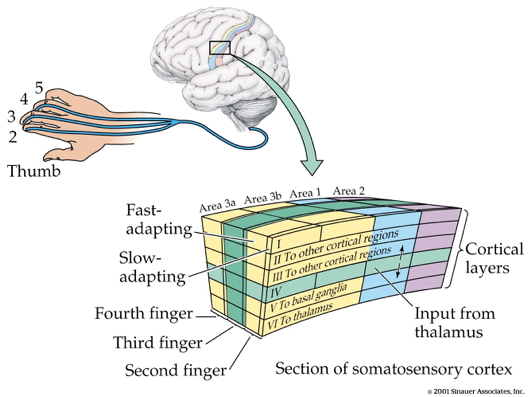
Somatotopic maps

  • In thalamus & cerebral cortex

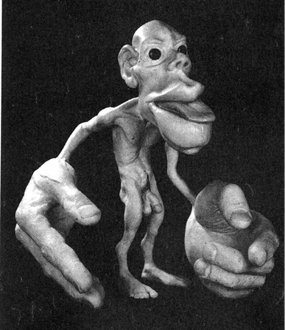
Maps non-uniform

  • Some areas of skin activate disproportionately sized areas of the cerebral cortex
    • hands, face, lips & tongue
  • More sensors in skin…
  • More axons to brain…
  • Larger areas in brain

Parallel pathways

  • S1 maintains functional segregation of input types
Interim summary

  • Perceiving Where
    • Somatotopic maps – locations on skin
    • Kinesthesia – configuration of limbs
  • Perceiving What
    • Patterns of smoothness, roughness, shape, temperature
  • Functional segregation
    • Multiple receptors, parallel axon pathways

Phantom Limbs

cogmonaut (2010)

Pain

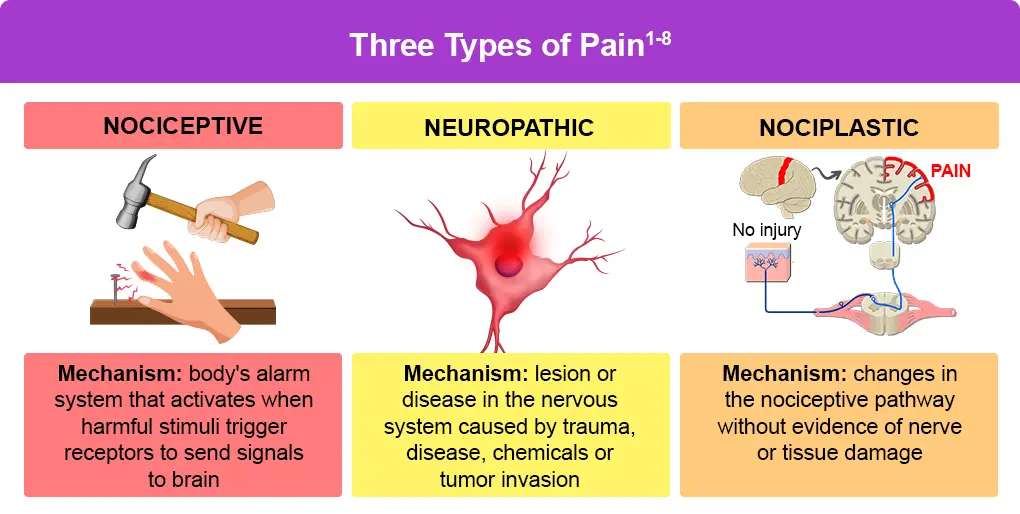
Types of

  • Nociceptive
  • Neuropathic
  • Nociplastic

Nociceptors

  • Nociceptors (Latin nocere to harm or hurt) detect harmful or potentially harmful stimuli
    • chemical
    • mechanical
    • thermal

“Nociceptors” (n.d.)

Nociceptor locations

  • External
    • Skin, cornea (eye), mucosa
  • Internal
    • Muscles, joints, bladder, gut

Projections to CNS

  • Fast (\(A\delta\)) and slow (\(C\)) transmission to CNS

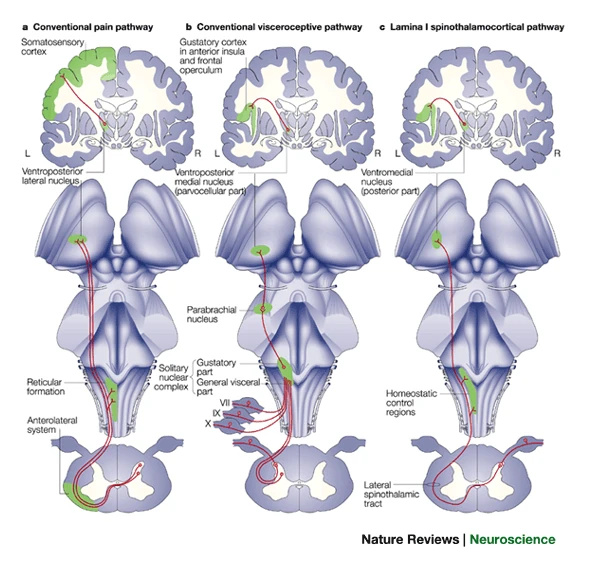
Projections to CNS

  • Via anterolateral system

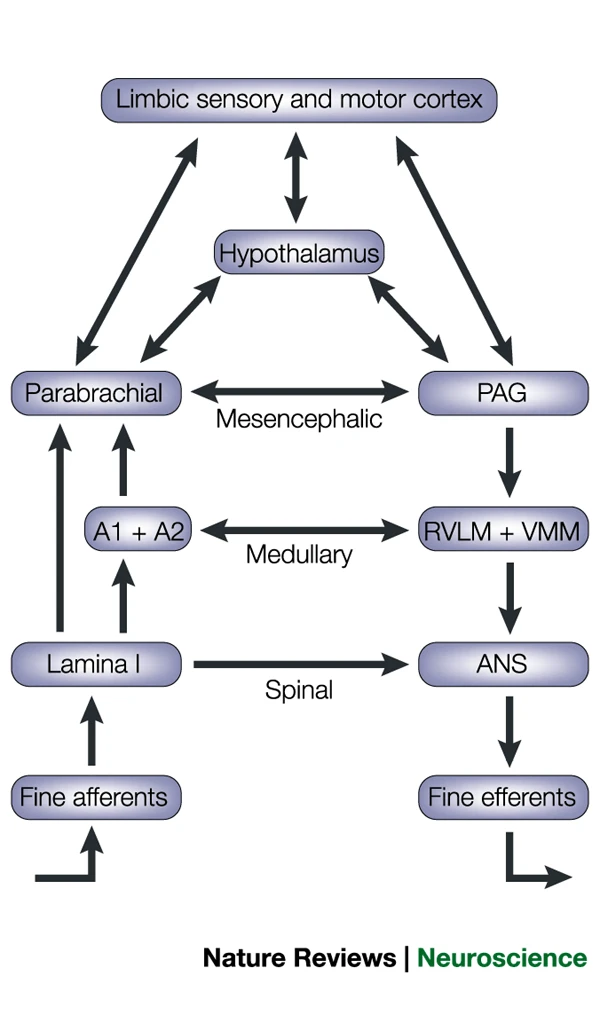
Craig (2002) Figure 1

Key CNS nodes

  • Periaqueductal grey (PAG) in midbrain
  • Insular cortex (insula)
  • Hypothalamus
  • Amygdala

Figure 2 from (Craig, 2002)

Key CNS nodes

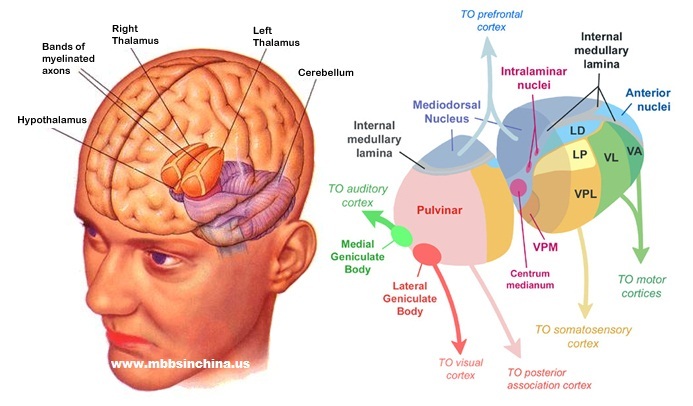
  • Thalamus
    • Ventroposterior lateral nucleus
    • Ventroposterior medial nucleus
    • Ventromedial nucleus

Pain in the brain

Wager et al. (2013) Figure 1

Pain in the brain

…we used machine-learning analyses to identify a pattern of fMRI activity across brain regions — a neurologic signature — that was associated with heat-induced pain. The pattern included the thalamus, the posterior and anterior insulae, the secondary somatosensory cortex, the anterior cingulate cortex, the periaqueductal gray matter, and other areas…

Wager et al. (2013)

Chemical factors

  • Substance P
    • Released by peripheral sensory nerves
    • Neurotransmitter and neuromodulator in PNS & CNS
    • Promotes vasodilation and inflammation
    • Wikipedia contributors (2025a)

Chemical factors

  • Prostaglandins
    • hormone-like effects, released in many places
    • Promotes vasodilation and inflammation
    • Wikipedia contributors (2025b)

Pain relief

  • Paracetymol (acetaminophen)
    • mechanism not fully understood
    • may inhibit synthesis of prostaglandins via cyclooxygenase (COX) enzyme
    • may modulate endocannabinoid system
  • Nonsteroidal anti-inflamatory drugs (NSAIDs): aspirin, ibuprofen
    • Also inhibit prostaglandins via COX

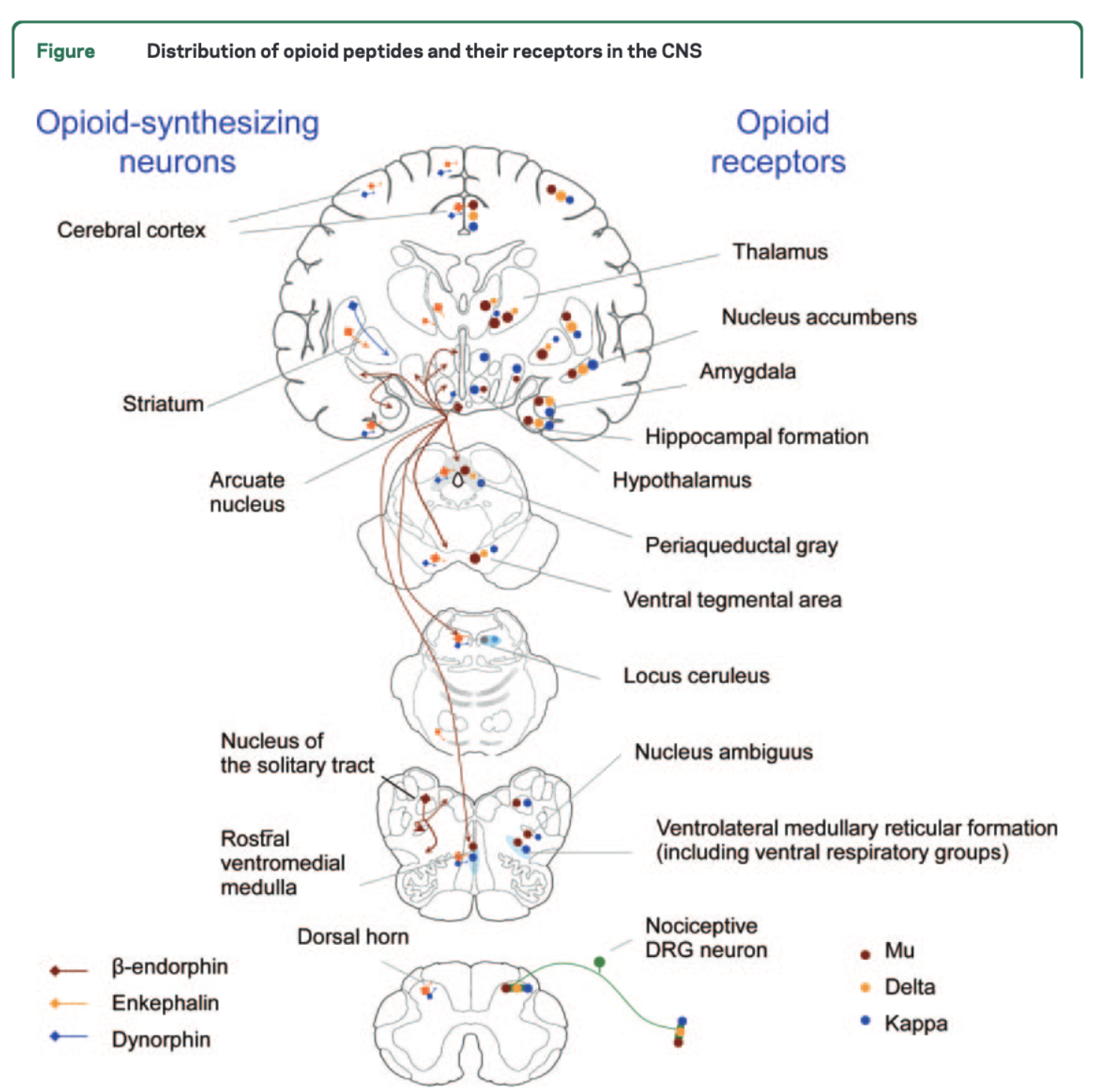
Pain relief: Opioids

  • Activate endogenous opioid systems
  • Multiple receptor types
    • \(\delta\), \(\kappa\), \(\mu\)

Figure 1 from Benarroch (2012)

Pain relief: Opioids

  • PNS: peripheral sensory neurons
  • CNS: amygdala, hypothalamus, PAG, spinal cord, cortex, medulla, pons,…
  • brainstem opioid neurons provide descending inhibition of nociceptors

Figure 1 from Benarroch (2012)

Synthetic Capsaicin

  • Binds to TrpV1/VR1 thermo/nociceptors
  • Eventually causes decrease in TrpV1 response
  • Alters how peripheral neuron responds to mechanical (rubbing) stimulation
  • Borbiro, Badheka, & Rohacs (2015)

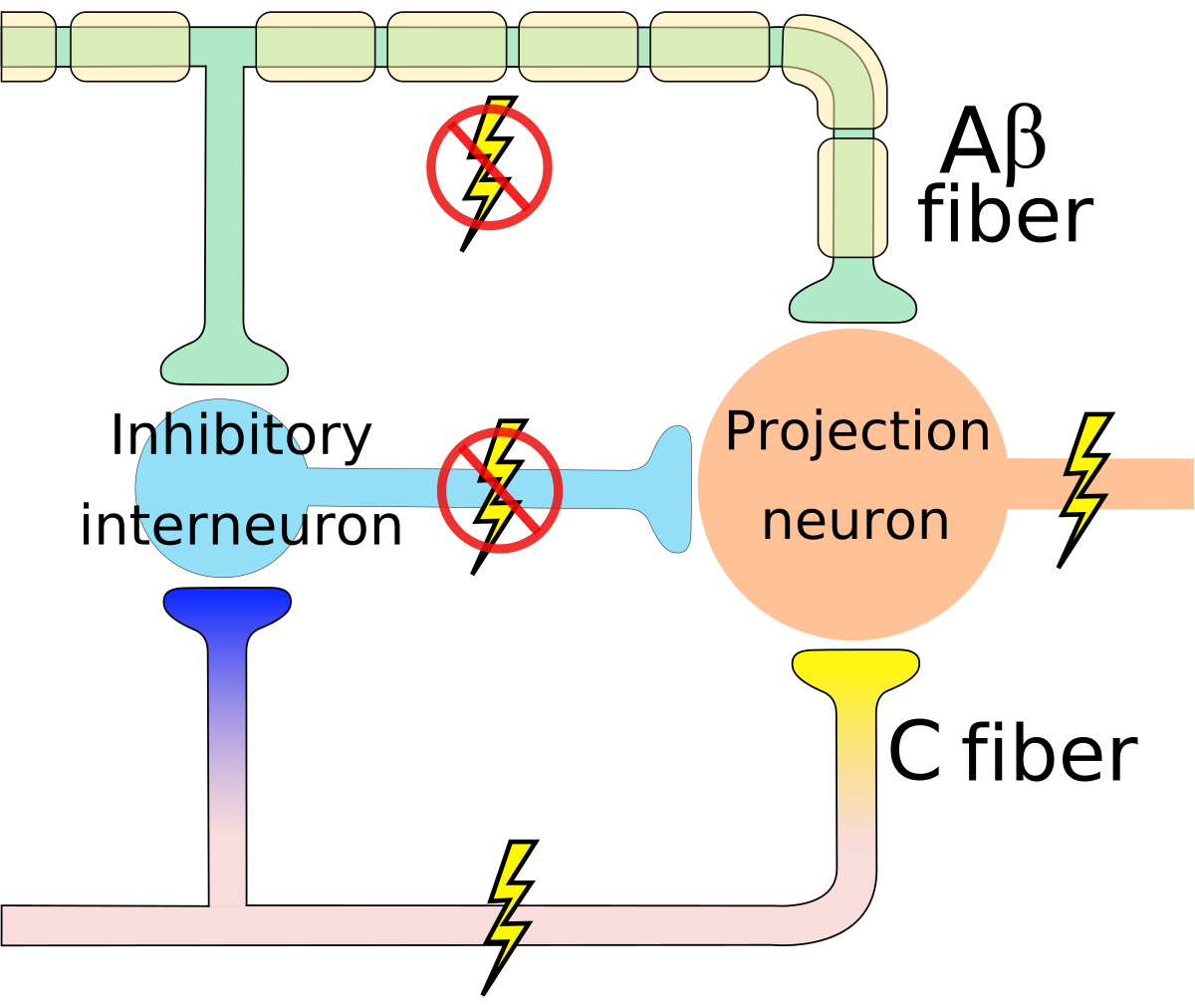
Why rubbing might help

Gate control theory

  • Melzack & Wall (1965)
  • Pain projection neurons receive nociceptive + non-nociceptive input
  • Non-nociceptive input activates inhibitory interneuron
Wikipedia

Pain’s multiple components

Figure 1 from Papini, Fuchs, & Torres (2015)

Interim summary

  • Specific receptors (nociceptors) for pain
  • Highly interconnected CNS network
  • Key nodes: PAG, amygdala, insula, nucleus accumbens, anterior cingulate
  • Some pain relievers target synthesis of prostaglandins
  • Endogenous opioid and cannabinoid receptors contribute
  • Experienced pain combination of physical and psychological factors

Wrap up

Next time

  • Action I
  • Exam 3 review

Resources

About

This talk was produced using Quarto, using the RStudio Integrated Development Environment (IDE), version r Sys.getenv("RSTUDIO_VER").

The source files are in R and R Markdown, then rendered to HTML using the revealJS framework. The HTML slides are hosted in a GitHub repo and served by GitHub pages: https://psu-psychology.github.io/psych-260-2025-fall/

References

Benarroch, E. E. (2012). Endogenous opioid systems: Current concepts and clinical correlations. Neurology, 79, 807–814. https://doi.org/10.1212/WNL.0b013e3182662098
Borbiro, I., Badheka, D., & Rohacs, T. (2015). Activation of TRPV1 channels inhibits mechanosensitive piezo channel activity by depleting membrane phosphoinositides. Science Signaling, 8, ra15. https://doi.org/10.1126/scisignal.2005667
Castilla, V. (2007). Vestibulo-ocular reflex 13/25. YouTube. Retrieved from https://www.youtube.com/watch?v=j_R0LcPnZ_w
cogmonaut. (2010). Phantom limb video. YouTube. Retrieved from https://www.youtube.com/watch?v=1mHIv5ToMTM
Craig, A. D. (2002). How do you feel? Interoception: The sense of the physiological condition of the body. Nature Reviews. Neuroscience, 3, 655–666. https://doi.org/10.1038/nrn894
Melzack, R., & Wall, P. D. (1965). Pain mechanisms: A new theory. Science, 150, 971–979. https://doi.org/10.1126/science.150.3699.971
Nociceptors. (n.d.). In Nociception and spinal reflexes. Retrieved from https://uw.pressbooks.pub/spinal/chapter/chapter-1/
Papini, M. R., Fuchs, P. N., & Torres, C. (2015). Behavioral neuroscience of psychological pain. Neuroscience and Biobehavioral Reviews, 48, 53–69. https://doi.org/10.1016/j.neubiorev.2014.11.012
Ross-Topic, D. (2018). Touch me in the morning. YouTube. Retrieved from https://www.youtube.com/watch?v=nvZfQzlS9t8
ThePoliceVEVO. (2010). The police - king of pain (official music video). YouTube. Retrieved from https://www.youtube.com/watch?v=yuOPRfq-q6U&list=RDyuOPRfq-q6U&start_radio=1
Wager, T. D., Atlas, L. Y., Lindquist, M. A., Roy, M., Woo, C.-W., & Kross, E. (2013). An fMRI-based neurologic signature of physical pain. The New England Journal of Medicine, 368, 1388–1397. https://doi.org/10.1056/NEJMoa1204471
Wikipedia contributors. (2025a, October 2). Substance P. Retrieved from https://en.wikipedia.org/wiki/Substance_P
Wikipedia contributors. (2025b, October 4). Prostaglandin. Retrieved from https://en.wikipedia.org/wiki/Prostaglandin