Action I

2025-11-20

Rick Gilmore

Department of Psychology

Prelude

Reviews (2012)

Announcements

  • Exam 3 on Tuesday, December 2, 2025

In the news

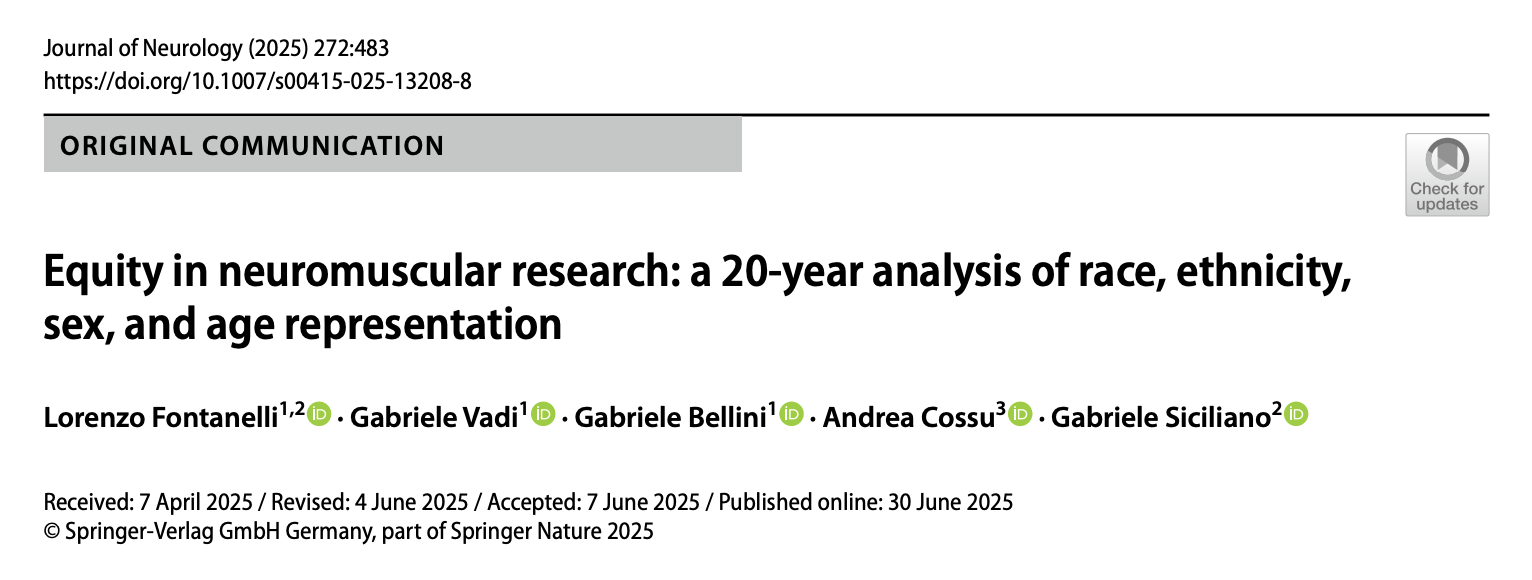
Fontanelli, Vadi, Bellini, Cossu, & Siciliano (2025)

Significant disparities persist in race, ethnicity, and age representation in neuromuscular disease clinical research, highlighting the need for more inclusive study designs.
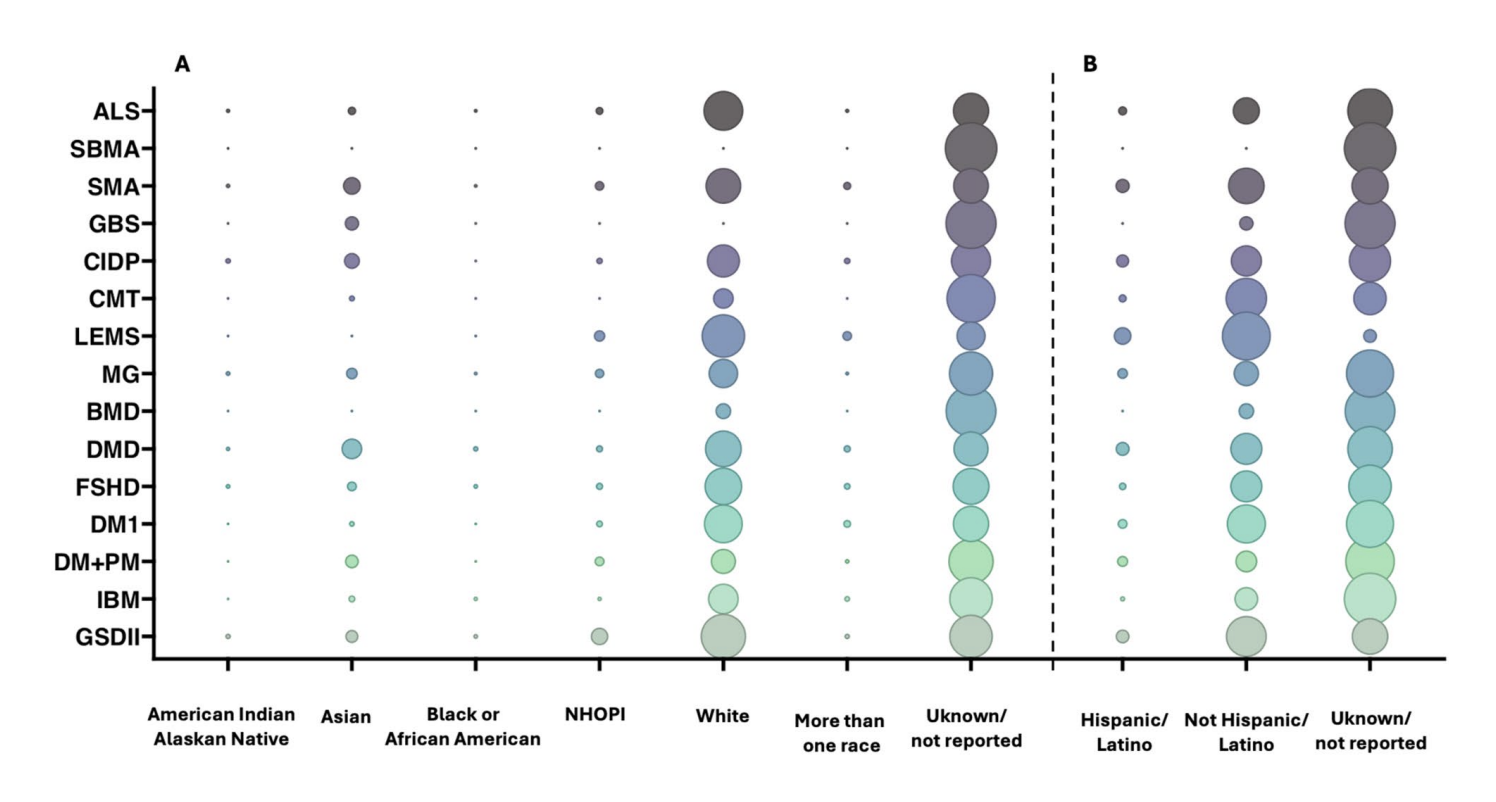
Fontanelli et al. (2025) Figure 2
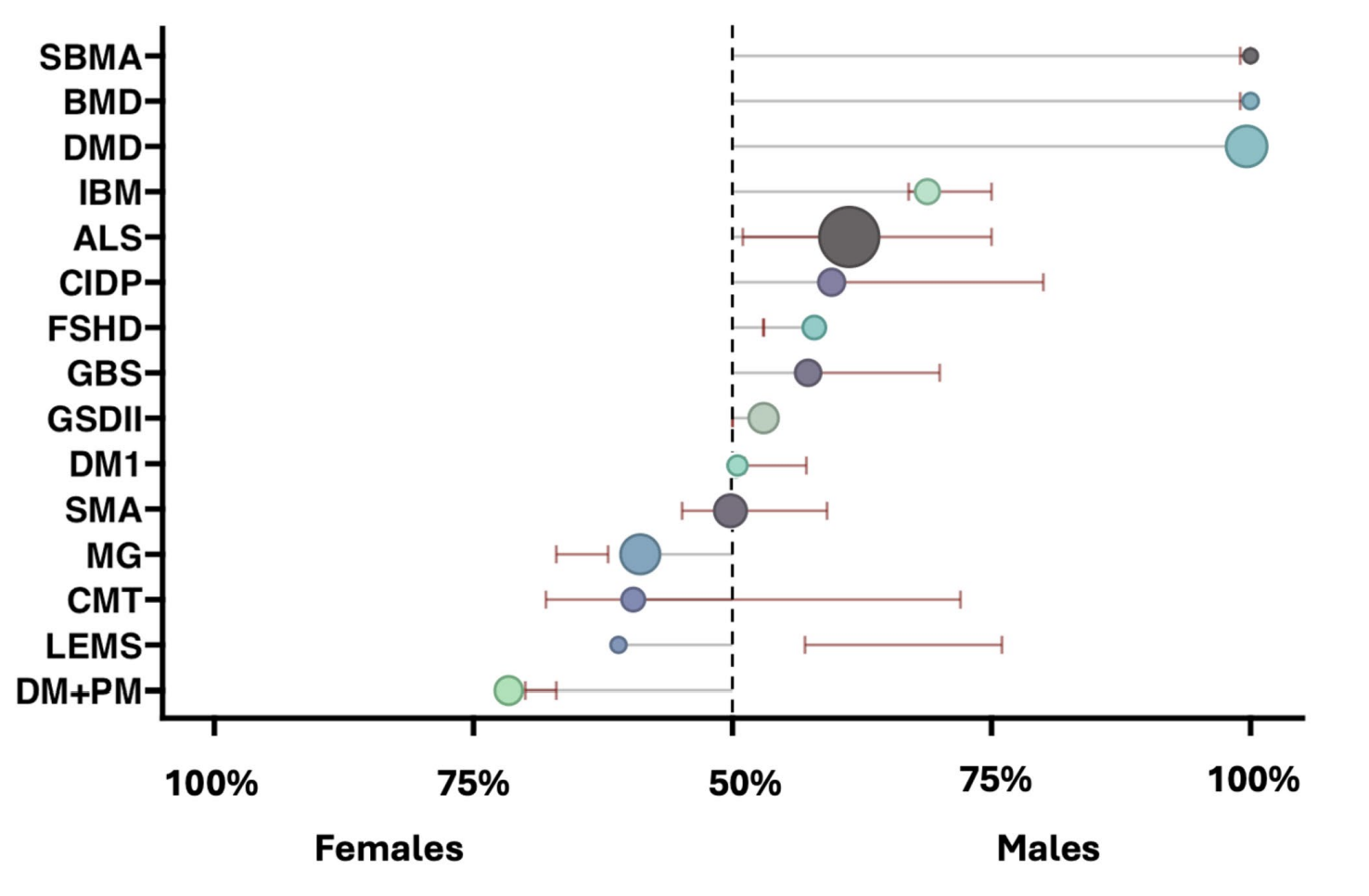
Fontanelli et al. (2025) Figure 3

Today’s topics

  • Warm up
  • Action
  • Exam 3 review

Warm up

All of the statements about the science of perception are true, except:

  • A. Scientific psychology started by focusing on perception.
  • B. Psychophysics is the discipline most closely associated with it.
  • C. The relationship between physical properties (like brightness) and perceptual judgements (like magnitude) are often non-linear.
  • D. People can’t report accurately or consistently about their perceptual experiences.

All of the statements about the science of perception are true, except:

  • A. Scientific psychology started by focusing on perception.
  • B. Psychophysics is the discipline most closely associated with the science of perception.
  • C. The relationship between physical properties (like brightness) and perceptual judgements (like magnitude) are often non-linear.
  • D. People can’t report accurately or consistently about their perceptual experiences.

There are clearly defined maps on the surface of the cerebral cortex for many sensory channels with the exception of:

  • A. Vision
  • B. Olfaction/gustation (chemical senses)
  • C. Audition
  • D. Somatosensation

There are clearly defined maps on the surface of the cerebral cortex for many sensory channels with the exception of:

  • A. Vision
  • B. Olfaction/gustation (chemical senses)
  • C. Audition
  • D. Somatosensation

“Minty”-tasting foods are also perceived as cool because:

  • A. The same receptor in the skin responds to menthol and cooler temperatures.
  • B. Separate receptors for menthol and cool temperatures activate the same regions of cortex.
  • C. Hot and cold receptors mix-up minty and spicy signals.
  • D. Most foods that use mint are served cold.

“Minty”-tasting foods are also perceived as cool because:

  • A. The same receptor in the skin responds to menthol and cooler temperatures.
  • B. Separate receptors for menthol and cool temperatures activate the same regions of cortex.
  • C. Hot and cold receptors mix-up minty and spicy signals.
  • D. Most foods that use mint are served cold.

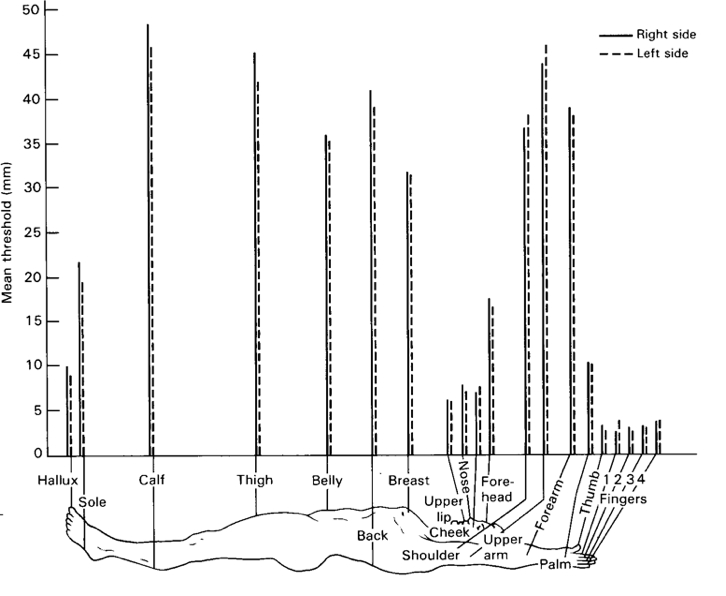
These areas of the skin have large numbers of cutaneous receptors:

  • A. Calf
  • B. Face
  • C. Fingertips
  • D. B and C.

These areas of the skin have large numbers of cutaneous receptors:

  • A. Calf
  • B. Face
  • C. Fingertips
  • D. B and C.

Action

Behavior as a system

  • Inputs (sensation/perception)
  • Processing (emotion/cognition)
  • Outputs

flowchart TD
  I(input) --> P[processing]
  P --> O(output)

Multiple outputs

  • Autonomic
  • Endocrine
  • Secretions, excretions
  • Behavior
    • Body movements
    • Vocalization

flowchart TD
  P(processing) --> A[ANS]
  P --> H(endocrine)
  P --> S(secretions, excretions)
  P --> B(behavior/action)
  B --> M(movements)
  B --> V(vocalizations)

Movement types 1

  • Locomotion
  • Reaching, grasping, manipulation
  • Facial expressions
  • Eye/head movements
  • Maintainance of posture, balance

Movement types 2

  • Reflexes
    • Simple, highly stereotyped, unlearned, rapid
  • vs. planned or voluntary actions
    • Complex, flexible, acquired, slower
    • Discrete (reaching) vs. rhythmic (walking)
    • Ballistic (no feedback) vs. controlled (feedback)
    • Sequential

Muscle types

  • Cardiac
  • Smooth
    • Arteries, hair follicles, uterus, intestines
    • Involuntary
    • Regulated by ANS

Types

  • Striated (striped)
    • Skeletal
    • Voluntary control
    • Mostly connected to tendons and bones
    • Regulated by somatic part of PNS

Skeletal muscle groups

  • Axial
    • Trunk, neck, hips
  • Proximal
    • Shoulder/elbow, pelvis/knee
  • Distal
    • Hands/fingers, feet/toes

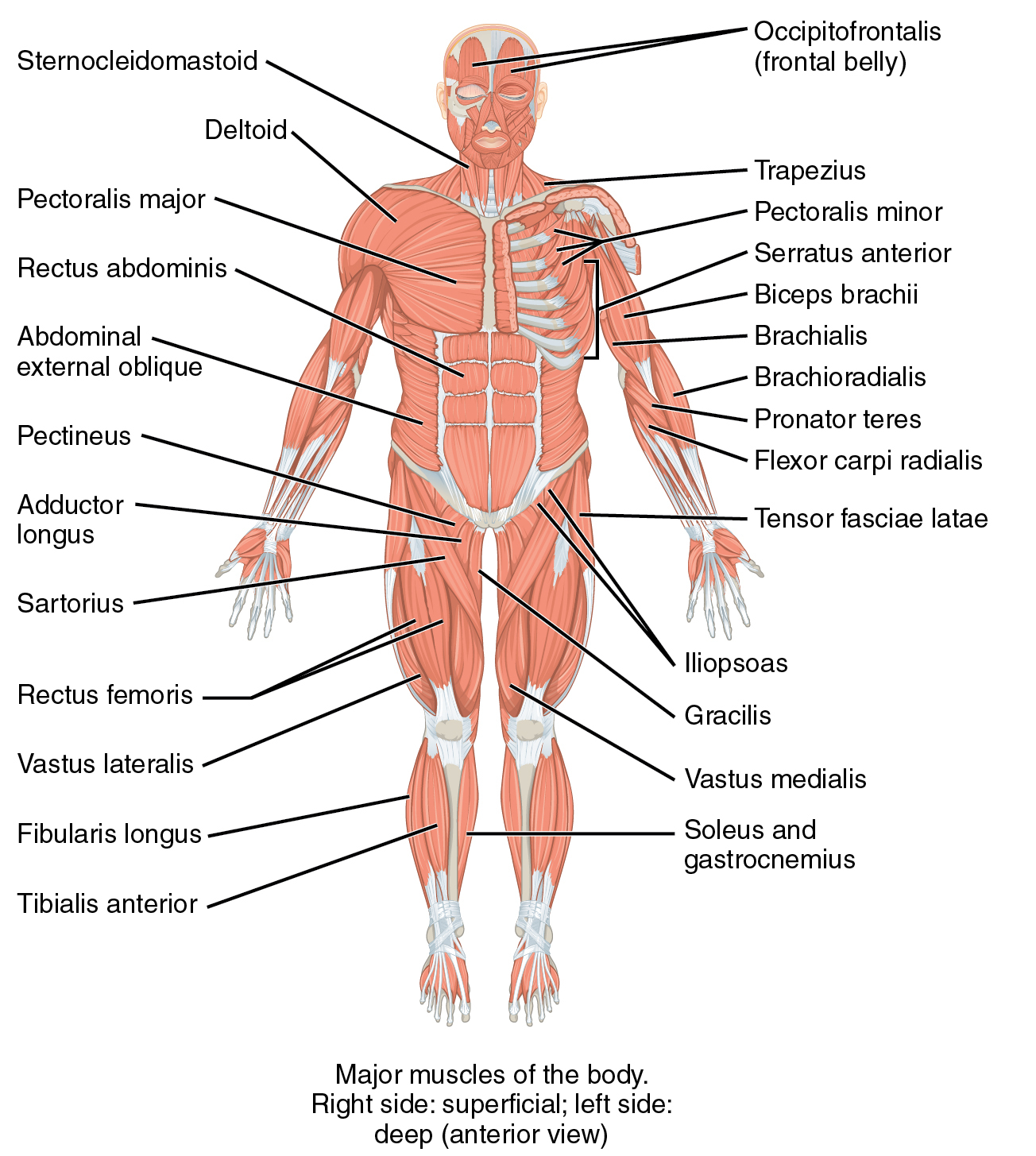
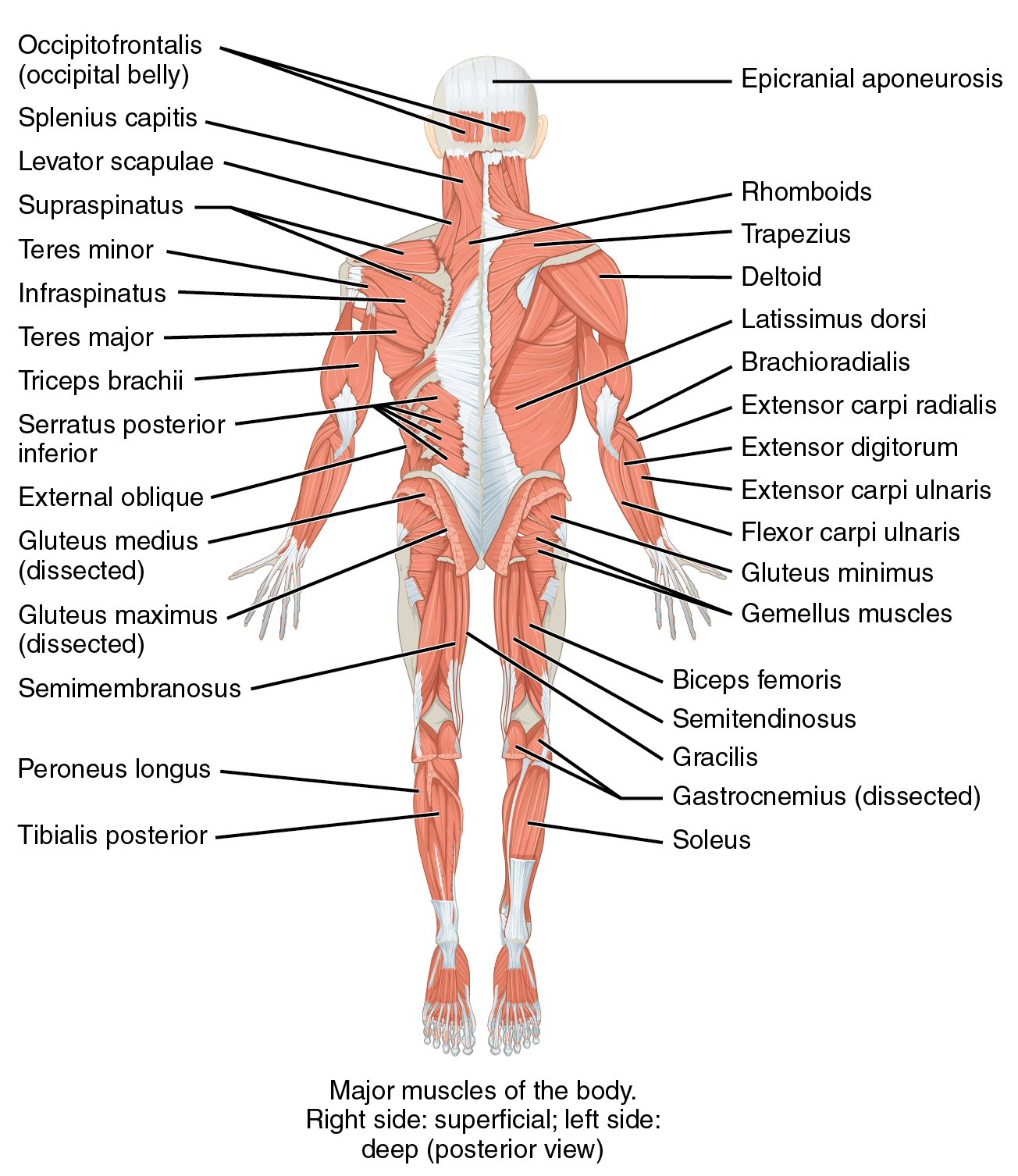
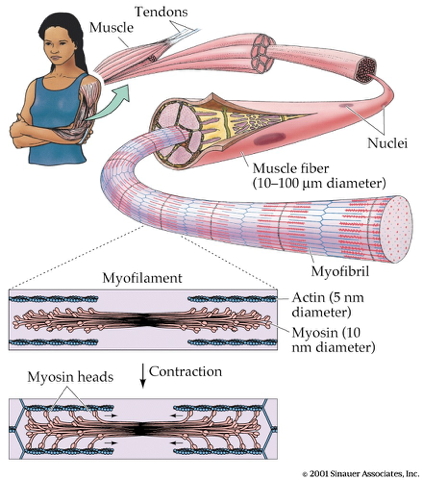
Skeletal muscles

  • 650+ muscles
  • 40% of total body mass
  • 50-75% of total body proteins
  • Frontera & Ochala (2015)
  • millions of motor neurons

Wikipedia

Wikipedia

Muscle fiber types

  • Fast twitch/fatiguing
    • Type II (A & B)
    • White meat
  • Slow twitch/fatiguing
    • Type I
    • Red/dark meat

From neuron to muscle

  • Motor neuron
    • Cell body in ventral or lateral horn of spinal cord
    • Axons exit spinal cord via ventral root
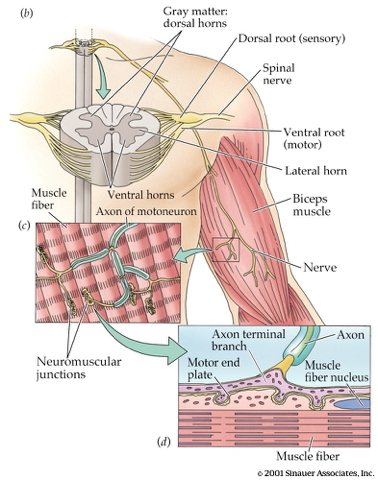
From neuron to muscle

  • Synapse at neuromuscular junction
    • Release acetylcholine (ACh) onto skeletal muscle fiber

From neuron to muscle

  • Motor endplate on muscle fiber
    • Contains nicotinic ACh receptors (nAChR)

From neuron to muscle

  • nAChR receptor opens
    • Na+ enters; K+ exits
    • Combined effect excitatory

From neuron to muscle

  • Generates excitatory endplate potential (EPP)
    • Muscle fiber depolarizes
    • Depolarization spreads along fiber
    • Ca++ released from stores inside muscle

  • Muscle fibers segmented into sarcomeres
  • Myofibrils (w/in sarcomere)
    • Paired actin & mysosin proteins
    • “Molecular gears”
  • Ca++ plus energy source (ATP)
    • Bind, move, unbind (repeat)

  • No “reverse” gear
    • Only contract
    • Must be pulled to stretch/extend
  • Muscles often arranged in agonist/antagonist pairs

Marionette analogy

Giphy: Bob Baker Marionette Theater

Muscles are sensory organs, too!

Muscle fiber types

  • Intrafusal fibers
    • Sense length/tension
    • Ennervated (contract) via gamma (\(\gamma\)) motor neuron activation
    • Contain muscle spindles (sensory organs linked to Ia afferents)
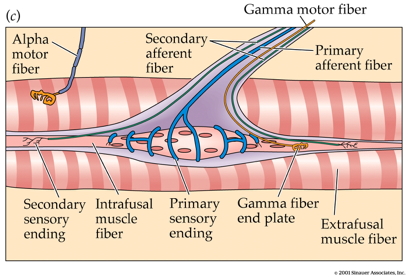
Muscle fiber types

  • Extrafusal fibers
    • Generate force
    • Ennervated (contract) via alpha (\(\alpha\)) motor neurons

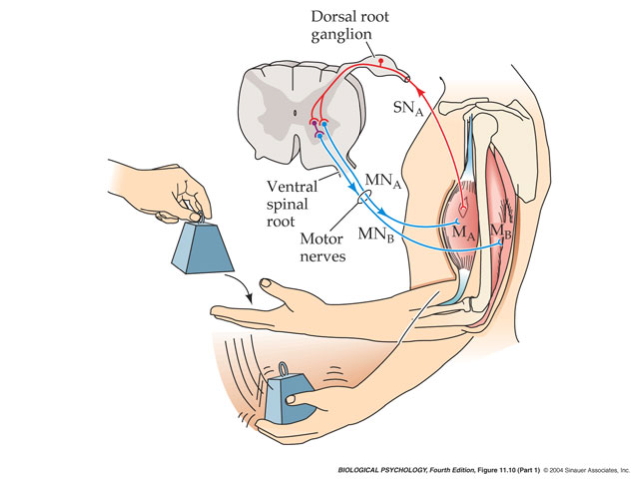
Monosynaptic stretch (myotatic) reflex

  • Muscle stretched (length increases)
  • Muscle spindle in intrafusal fiber activates
  • Ia afferent sends signal to spinal cord
    • Activates alpha (\(\alpha\)) motor neuron
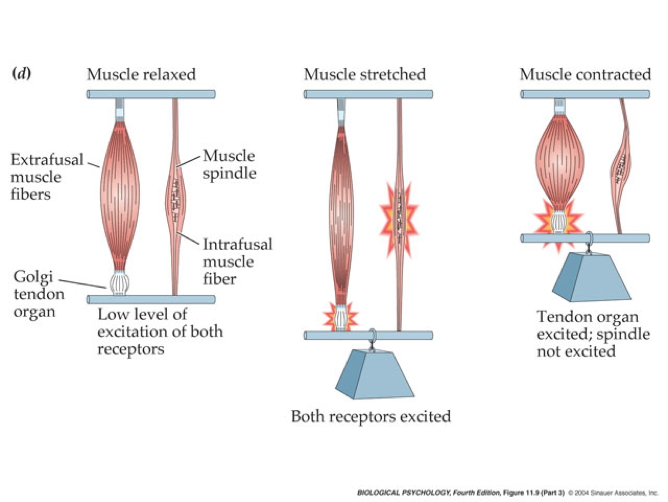
Monosynaptic stretch (myotatic) reflex

  • Muscle contracts, shortens length
  • Gamma (\(\gamma\)) motor neuron fires to take up intrafusal fiber slack

Avoiding tremor

  • Polysynaptic inhibition of antagonist muscle

  • Prevents/dampens tremor

  • Remember: Brain gets fast(est) sensory info from spindles
Why this matters…

Interim summary

  • 650+ skeletal muscles control voluntary human movement, balance/posture control
  • Large diameter, thickly myelinated axons control skeletal muscles
  • Motor neurons release ACh onto nicotinic receptors (AChR) in motor endplate

Interim summary

  • Depolarization of muscle fiber causes Ca++ release
    • Triggers actin & myosin proteins to cause muscle contraction
  • Muscles are sensory organs AND force/movement producers
  • Monosynaptic stretch reflex

Exam 3 review

Evolution & Development

  • Loss of neurons and synapses
  • Mammalian brain sizes vs. other animal groups
  • When does myelination in the human brain finish?
  • Where does the adult brain retain the ability to generate new neurons and glia

Disorder

  • Treatments for MDD, bipolar, schizophrenia
  • Brain abnormalities in schizophrenia
  • Glutamate hypothesis of schizophrenia; monoamine

Emotion

  • Locationist theory
  • Plutchik
  • Comparing animal “emotions” to human ones
  • Acute vs. chronic stressors
  • Cortisol response

Emotion

  • Roles of amygdala, especially in threat/“fear” conditioning
  • Major nodes of the reward pathway
  • Effects found by Milner and Olds following electrical stimulation in the ventral midbrain

Sensory Systems

  • Interoceptive vs. exteroceptive
  • How receptive field size relates to perceptual sensitivity
  • Lobes of the cerebral cortex associated with V1, S1, A1, and M1
  • How smartphone sensors are like human sensory systems

Somatosensation

  • What properties skin receptors respond to
  • Cutaneous receptors that respond to chemical and thermal (temperature) info
  • Associated nuclei of the thalamus
  • Parts of the skin with especially small receptive fields (high tactile acuity)

Anatomy

  • Location of the cerebral ventricles

Wrap up

Next time

  • Exam 3

Resources

About

This talk was produced using Quarto, using the RStudio Integrated Development Environment (IDE), version r Sys.getenv("RSTUDIO_VER").

The source files are in R and R Markdown, then rendered to HTML using the revealJS framework. The HTML slides are hosted in a GitHub repo and served by GitHub pages: https://psu-psychology.github.io/psych-260-2025-fall/

References

Fontanelli, L., Vadi, G., Bellini, G., Cossu, A., & Siciliano, G. (2025). Equity in neuromuscular research: A 20-year analysis of race, ethnicity, sex, and age representation. Journal of Neurology, 272, 483. https://doi.org/10.1007/s00415-025-13208-8
Frontera, W. R., & Ochala, J. (2015). Skeletal muscle: A brief review of structure and function. Calcified Tissue International, 96, 183–195. https://doi.org/10.1007/s00223-014-9915-y
Reviews, B. &. T. (2012). I like to move it (original video) madagascar HD. YouTube. Retrieved from https://www.youtube.com/watch?v=hdcTmpvDO0I