Memory

2025-12-09

Rick Gilmore

Department of Psychology

Prelude

timvitkuske (2014)

Announcements

  • Exam 4 (Final), 4:40-6:30 pm in 114 Steidle
  • 40 questions + bonus

Today’s topics

  • What is learning? What is memory?
  • Biological bases of memory
  • Disorders of memory
  • Quiz 4

What is learning? What is memory?

What is learning?

  • Acquisition of new knowledge, skills, responses…
  • Change in existing knowledge, skills, responses…

Types of learning?

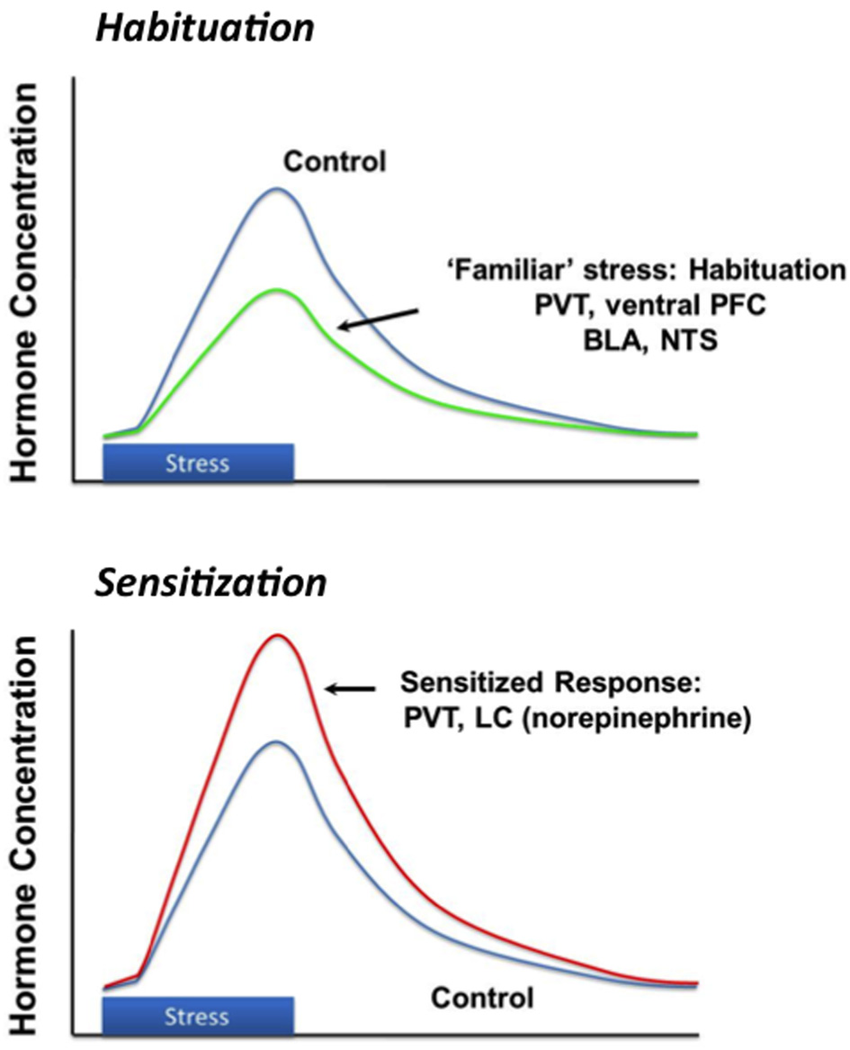
  • Non-associative
    • Change in response to repeated encounters with same stimulus/event
    • Habituation -> weaker response
    • Sensitization -> stronger response

Types of learning

  • Associative
    • “Associates” or links two events/items with one another
    • Classical conditioning
      • Link event with physiological response

Types of learning

  • Operant/instrumental conditioning
    • Link behaviors with external events (rewards/punishments)

Associative learning

  • Types
    • Observational/imitative

Associative learning

  • Types
    • Sequence
      • A, B, C, D, …
    • Episodic
      • Mom’s 85th
    • Semantic
      • Thanksgiving is a holiday celebrated in Canada and the U.S…

What is memory?

Memory capacity of the human brain?

  • 1e12 neurons
  • 1e3 synapses/neuron
  • 1e15 synapses or 1.25e14 bytes
  • 1e9 gigabyte, 1e12 terabyte, 1e15 petabyte

“Entirety of a human’s lived experience could fit on a flash drive.”

Reber (2010)

Computer memory

  • Random Access Memory (RAM), short-duration storage
  • Hard-disk/flash drive storage, long-term duration
  • Addressable (location ‘010101’)
  • {text, sounds, images, video, data} all in binary [0,1] format
    • 00110000 == 48 (the number)
    • 00110000 == ‘0’ (the character zero)
  • Write once, read many times

Computers vs. brains

  • Computers have separate memory hardware
    • brains store info everywhere
  • Computers have addressable memory
    • brain memory??
  • Computer memory can be non-volatile
    • brain memories fade
  • Computer memory is veridical
    • brain memories are ‘reconstructions’

Biological bases of memory

Types

  • Short-term vs. long-term
    • Working memory ~ short-term information maintenance for guiding action
  • Explicit (declarative: semantic vs. episodic; ‘knowing that’) vs. implicit (procedural or ‘knowing how’)

Types

  • Retrospective (from the past) vs. prospective (to be remembered)
  • How tested or revealed?
    • Recognition vs.
    • Recall:

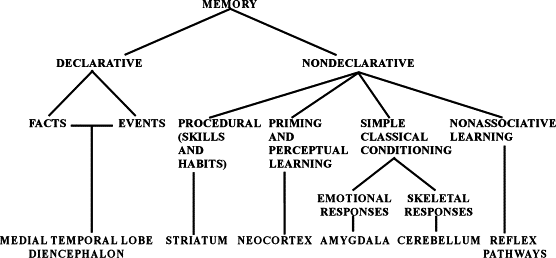
A taxonomy

Squire (2004)

Mechanism(s)

The idea that memory is stored as enduring changes in the brain dates back at least to the time of Plato and Aristotle (circa 350 BCE), but its scientific articulation emerged in the 20th century when Richard Semon introduced the term “engram” to describe the neural substrate for storing and recalling memories.

Josselyn & Tonegawa (2020)

Mechanism(s)

Essentially, Semon proposed that an experience activates a population of neurons that undergo persistent chemical and/or physical changes to become an engram. Subsequent reactivation of the engram by cues available at the time of the experience induces memory retrieval.

Josselyn & Tonegawa (2020)

Neural substrates (engrams) consist of

  • Changes in patterns of neural activity
  • Changes in connectivity
    • New synapses
    • Altered synapses (strengthened or weakened)

Donald Hebb

  • Canadian clinical neuropsychologist
  • Author of The Organization of Behavior (1949)

Hebbian learning

When an axon of cell A is near enough to excite cell B and repeatedly or persistently takes part in firing it, some growth process or metabolic change takes place in one or both cells such that A’s efficacy, as on of the cells firing B, is increased.

Hebb (1949)

Hebbian learning

Neurons that fire together wire together.

Löwel & Singer (1992)

Hebbian learning is associative

  • Neuron A active &
  • Neuron B active \(\rightarrow\)

flowchart LR
  A --> B

  • Strengthen link (synapse) between them

flowchart LR
  A ==> B

How synapses strengthen

  • Long-term potentiation (LTP)
  • Make more potent (stengthen) synapse based on recent co-activity
  • Change at synapse == physical basis of Hebbian learning

Hebbian learning mechanism
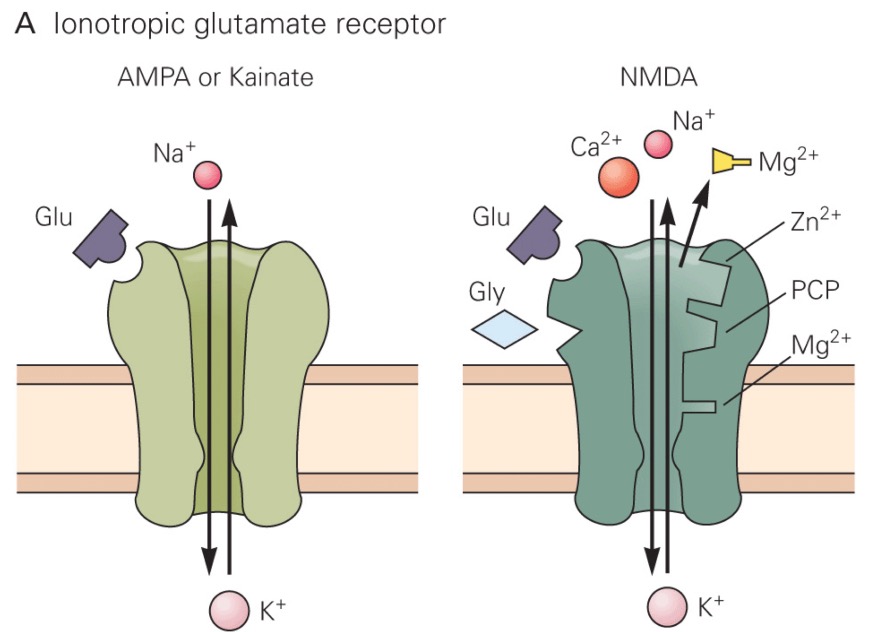
NMDA-R from “Pitt medical neuroscience” (n.d.)
  • N-methyl-D-aspartate receptor (NMDA-R)
  • ‘Coincidence’ detector
    • Sending cell has released NT
    • Receiving cell is/has been recently active

NMDA-R

NMDA-R from “Pitt medical neuroscience” (n.d.)
  • Chemically-gated
    • Binds glutamate
      • When nearby neuron releases
    • Binds glycine (co-factor/co-agonist)
    • So, ligand-gated

NMDA-R

NMDA-R from “Pitt medical neuroscience” (n.d.)
  • Voltage-gated
    • Receiving cell depolarizes (EPSP)
    • \(Zn^{++}\) or \(Mg^{++}\) ion ‘plug’ repelled under depolarization
    • \(Na^+\) & \(Ca^{++}\) influx; \(K^+\) outflux

https://i2.wp.com/www.gatewaypsychiatric.com/wp-content/uploads/2015/02/NMDA-Receptor-and-Depression.jpg?ssl=1

Schematic

flowchart LR
  A -->|Glu| B

flowchart LR
  A -->|Glu| C[AMPA-R]
  A -->|Glu| B[NMDA-R]
  C --> |generates EPSP| B
  B --> |Ca++ enters| D:::hidden
  
  %% Clickable links
  click C "https://en.wikipedia.org/wiki/AMPA_receptor"
  click B "https://en.wikipedia.org/wiki/NMDA_receptor"

  • Ca++ entry strengthens synapse
  • Modulate existing AMPA-R; synthesize new AMPA-R

NMDA-Rs & associative learning

  • Receptors associate (link)
    • Concept A -> Concept B
    • Neuron A -> Neuron B
  • I say Donald…you say…

Wikipedia

NMDA-R clinical significance

  • Memantine
    • Alzheimer’s Disease treatment
    • NMDA-R antagonist
  • Phencylidine (PCP)
    • Dissociative anesthetic, may induce hallucinations
    • Glutamate hypothesis of schizophrenia
    • NMDA-R antgonist

NMDA-R clinical significance

  • Ketamine
    • anesthesia, sedation, pain relief
    • short-term, fast acting relief for depression
    • NMDA-R antagonist
  • Ethanol also influences (Ron & Wang, 2011)

Summary

  • Learning and memory involve changes in neural firing, circuitry
    • And probably molecular changes inside neurons
  • Hebbian learning a type of associative learning

Summary

  • NMDA-R is coincidence detector
    • Molecular basis of one form of long-term potentiation (LTP)
  • Unlike computers, brains store different types of information stored in different brain systems

Disorders of memory

  • Amnesia
  • Alzheimer’s Disease

Amnesia

  • Acquired loss of memory
  • ≠ normal forgetting
  • Note: computers don’t forget

Types

  • Retrograde (‘backwards’ in time)
    • Damage to information acquired pre-injury
    • Temporally graded
  • Anterograde (‘forward’ in time)
    • Damage to information acquired/experienced post-injury

Patient HM1

  • Intractable/untreatable epilepsy
  • Bilateral resection of medial temporal lobe (1953)
  • Epilepsy now treatable
  • But, memory impaired

Patient HM

  • Retrograde amnesia1
    • Couldn’t remember 10 yrs before operation
    • Distant past better than more recent

Patient HM

  • Severe, global anterograde amnesia1
    • Impaired learning of new facts, events, people
  • But, skills (mirror learning) intact

Grafe (2019)

HM

Every day is alone in itself, whatever enjoyment I’ve had, and whatever sorrow I’ve had…Right now, I’m wondering, have I done or said anything amiss? You see at this moment, everything looks clear to me, but what happened just before? That’s what worries me. It’s like waking from a dream. I just don’t remember.

– HM

Other causes of amnesia

  • Disease
    • Alzheimer’s, herpes virus
  • Korsakoff’s syndrome
    • Result of severe alcoholism
    • Impairs medial thalamus & mammillary bodies
  • Brain injury

Patient NA

  • Fencing accident
  • Damage to medial thalamus
  • Anterograde + graded retrograde amnesia
  • Are thalamus & medial temporal region connected?

Anagnostaras (2014)

Spared skills in amnesia

  • Skill-learning
  • Mirror-reading, writing
  • Short-term memory
  • “Cognitive” skills
  • Priming

What does amnesia tell us?

  • Long-term memory for facts & people (semantic), events (episodic)
    • ≠ Short-term memory
    • ≠ Long-term memory for “skills”

Multiple types of memory

Squire (2004)
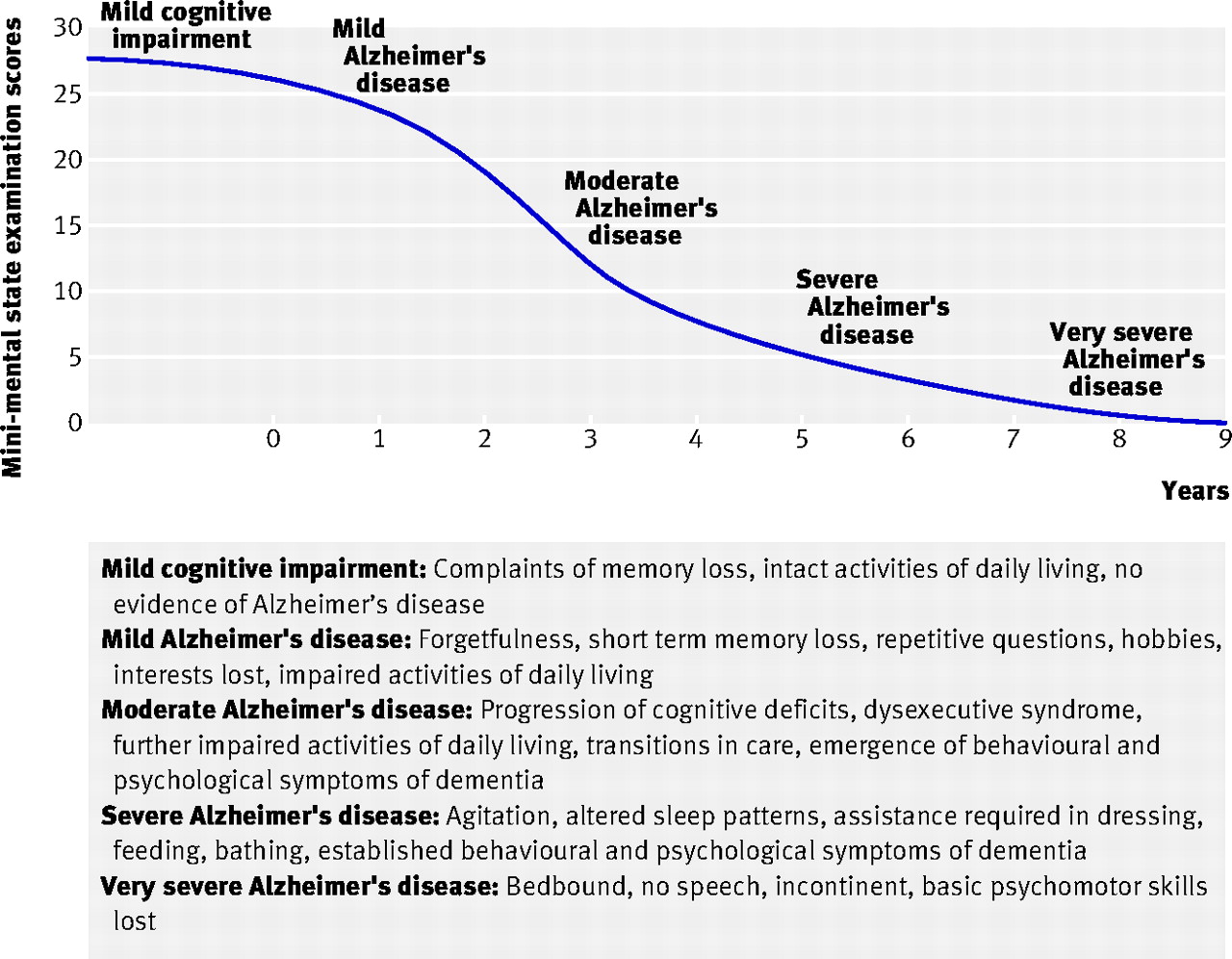
Alzheimer’s Disease (AD)

  • Chronic, neurodegenerative disease affecting ~6.7 M Americans
  • Cognitive dysfunction (memory loss, language difficulties, planning, coordination)
  • Psychiatric symptoms and behavioral disturbances
  • Difficulties with daily living
  • Burns & Iliffe (2009)

Burns & Iliffe (2009)

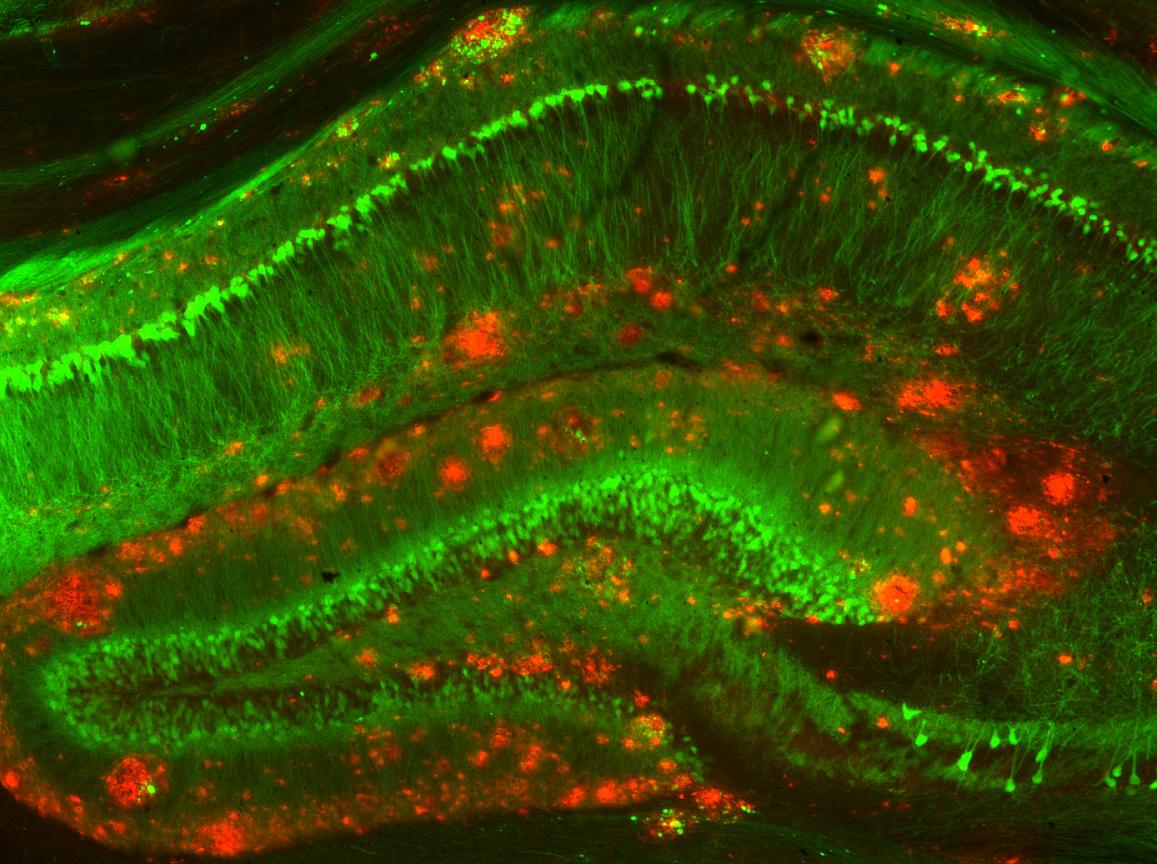
In the brain

  • Post-mortem exams show \(\beta\) amyloid plaques and neurofibrillary tangles in hippocampus + other brain areas
AD Treatments

  • Drugs that address amyloid \(\beta\) don’t work especially well
  • Acetylcholinesterase (AChE) inhibitors (e.g. Aricept)
    • ACh a neuromodulator in the brain
    • AChE inhibitors boost/prolong ACh levels

AD Treatments

  • NMDA-R partial antagonists (e.g., Memantine)
    • Slow/impede formation of disordered new memories to keep established ones intact?
  • Is AD the result of disordered immune response? (Jevtic, Sengar, Salter, & McLaurin, 2017)

Alzheimer’s Disease (AD)

GBD 2019 Dementia Forecasting Collaborators (2022) Figure 3. Percentage change between 2019 and 2050 in all-age number of individuals with dementia by country.

Quiz 4

1. The NMDA receptor binds which neurotransmitter?

  • A. GABA
  • B. Norepinephrine
  • C. Glutamate
  • D. Dopamine

2. Which of the following statements about the NMDA receptor is FALSE?

  • A. It is ionotropic.
  • B. It is metabotropic.
  • C. It is voltage-gated.
  • D. It is found in multiple places in the CNS, especially in the hippocampus.

3. Unlike computers, biological memories are stored in patterns of neuronal activations and synaptic strengths distributed across areas of the nervous system.

  • A. True
  • B. False

4. The entry of what ion into the postsynaptic cell through NMDA receptors triggers long-term potentiation (LTP)?

  • A. Cl- (chloride)
  • B. Ca++ (calcium)
  • C. Mg++ (magnesium)
  • D. K+ (potassium)

5. Who did not say this exactly but is credited with the idea that ‘neurons that fire together wire together.’

  • A. William James
  • B. Henry Molaison
  • C. Donald Hebb
  • D. Brenda Milner

6. True or False: Patient HM was largely unimpaired in his abilities to perform the mirror drawing task.

  • A. True
  • B. False

7. This neurotransmitter is released by motor neurons onto skeletal muscle fibers.

  • A. Dopamine
  • B. Glutamate
  • C. Serotonin
  • D. Acetylcholine

8. If you enjoyed dark meat from a Thanksgiving turkey, you may recall that this meat comes from muscles that are…

  • A. Slow-twitching & slow to fatigue
  • B. Fast-twitching & fast to fatigue
  • C. Not activated by alpha (\(\alpha\)) motor neurons
  • D. Medium-twitching & fast to fatigue

9. Muscles have receptors that sense this property:

  • A. Rhythm
  • B. Temperature
  • C. Speed of contraction
  • D. Length or tension

10. The myotatic/stretch reflex is called monosynaptic because…

  • A. It involves a single synapse from stretch receptor to muscle fiber
  • B. It involves multiple synapses from stretch receptors onto cortical neurons
  • C. Only one synapse is needed to activate an entire muscle
  • D. A motor neuron exiting the spinal cord only makes one synapse.

11. True or False: Primary motor cortex contains a topographical map of the body surface analogous to the somatosensory map.

  • A. True
  • B. False

12. In addition to long-term potentiation (LTP) and exocytosis, Ca++ ion flow contributes to…

  • A. Pressure signaling via \(I_\alpha\) efferents.
  • B. Muscle fiber contraction
  • C. Hyperpolarization of the nicotinic GABA receptor
  • D. The therapeutic effects of lithium (Li) in MDD

Next time

  • Frontiers in neuroscience
  • Exam 4 review
  • The Cerebral Sympony

Resources

About

This talk was produced using Quarto, using the RStudio Integrated Development Environment (IDE), version 2025.9.2.418.

The source files are in R and R Markdown, then rendered to HTML using the revealJS framework. The HTML slides are hosted in a GitHub repo and served by GitHub pages: https://psu-psychology.github.io/psych-260-2025-fall/

References

Anagnostaras, S. (2014). Larry Squire’s amnesic Patient NA. YouTube. Retrieved from https://www.youtube.com/watch?v=1GfFopZSyj8
Burns, A., & Iliffe, S. (2009). Alzheimer’s disease. BMJ, 338, b158. https://doi.org/10.1136/bmj.b158
GBD 2019 Dementia Forecasting Collaborators. (2022). Estimation of the global prevalence of dementia in 2019 and forecasted prevalence in 2050: An analysis for the global burden of disease study 2019. The Lancet. Public Health, 7, e105–e125. https://doi.org/10.1016/S2468-2667(21)00249-8
Grafe, L. (2019). Brenda milner on HM. YouTube. Retrieved from https://www.youtube.com/watch?v=aw6JmZuLhfA
Hebb, D. O. (1949). The organization of behavior; A neuropsychological theory (Vol. 335). Oxford, England: Wiley. Retrieved from https://psycnet.apa.org/fulltext/1950-02200-000.pdf
Jevtic, S., Sengar, A. S., Salter, M. W., & McLaurin, J. (2017). The role of the immune system in Alzheimer disease: Etiology and treatment. Ageing Research Reviews, 40, 84–94. https://doi.org/10.1016/j.arr.2017.08.005
Josselyn, S. A., & Tonegawa, S. (2020). Memory engrams: Recalling the past and imagining the future. Science. https://doi.org/10.1126/science.aaw4325
Löwel, S., & Singer, W. (1992). Selection of intrinsic horizontal connections in the visual cortex by correlated neuronal activity. Science, 255, 209–212. https://doi.org/10.1126/science.1372754
Pitt medical neuroscience. (n.d.). Retrieved April 19, 2023, from http://pittmedneuro.com/glutamate.html
Reber, P. (2010, May 1). What is the memory capacity of the human brain? Retrieved December 3, 2025, from https://www.scientificamerican.com/article/what-is-the-memory-capacity/
Ron, D., & Wang, J. (2011). The NMDA receptor and alcohol addiction. In A. M. Van Dongen (Ed.), Biology of the NMDA receptor. Boca Raton (FL): CRC Press/Taylor & Francis. Retrieved from https://www.ncbi.nlm.nih.gov/pubmed/21204417
Squire, L. R. (2004). Memory systems of the brain: A brief history and current perspective. Neurobiology of Learning and Memory, 82(3), 171–177. https://doi.org/10.1016/j.nlm.2004.06.005
timvitkuske. (2014, May). Betty buckley - memory (1983 tony awards). Youtube. Retrieved from https://www.youtube.com/watch?v=5mlllRdIfqw