The Cerebral Symphony
2025-12-11
Department of Psychology
Prelude
– Rlzee (2010)
Announcements
- Exam 4 (Final), 4:40-6:30 pm in 114 Steidle
- 40 questions + bonus
Today’s topics
- Jore Adegboyo presentation
- Exam 4 review
- Frontiers in neuroscience
- Careers in neuroscience
- The Cerebral Symphony
Exam 4 Review
History
- Descartes thought
____about the____ - What fluid fills the cerebral ventricles? This fluid was once thought to
____
Methods
- Single unit recordings have
____spatial and____temporal resolution. - EEG has
____spatial and____temporal resolution. - Single unit recordings measure
____; EEG measures____.
Anatomy
- Directional terms, slices
- In the human forebrain
____and superior are analogous to one another.
- In the human forebrain
- Gross anatomy
- The
____means “little brain” in Latin; it’s located adjacent to_____. - The
____and____in the midbrain release dopamine. - The
____controls endocrine and ANS activity.
- The
Anatomy
- Gross anatomy
- The insula is located deep inside the
____. - The amygdala is located in what lobe?
- Primary auditory cortex is located where?
- The insula is located deep inside the
Cellular anatomy
- Neurons receive most of their input on the
____and____. - Gray matter is made of
____; white matter is made of____.
Neurophysiology
- Resting potential
- In neuron at rest,
____inside is greater than outside; What force(s)____push Na+ inward?
- In neuron at rest,
- Ca++ influx is involved in
____,____, and____. - When Na+ enters a postsynaptic terminal, it creates what kind of potential?
- EPSP/IPSPs are
____than action potentials.
Neurophysiology
- Nodes of Ranvier contain lots of
____-gated channels - The absolute refractory period occurs when voltage-gated Na+ channels
____ - Action potential phases, causes, components
- Synaptic transmission
- EPSPs, IPSPs
- Synaptic plasticity, LTP, NMDA receptors
Neurochemistry
- ‘Big Three’ – Glu, GABA, ACh
- Which neurotransmitter is bound at the majority of synapses in the CNS?
- What factors distinguish neuromodulators (DA, NE, 5-HT, etc.) from other NTs?
Neurochemistry
- Hormones
- Oxytocin, vasopressin are released from
____.
- Oxytocin, vasopressin are released from
- Can we readily measure neurotransmitter levels in the brain?
- Midbrain structures that release dopamine are
_______and_______.
Evolution and development
- There is a “mammalian” brain plan (True/False)
Disorder and disease
- What are some structural changes in the brain associated with major depressive disorder and schizophrenia?
_____are a relatively new, fast-acting treatment for depression.- True or False: There exist convenient tests for monoamine neurotransmitter levels equivalent to the blood test available for Lithium.
Disorder and disease
- How strong is the evidence that serotonin deficits are common in MDD?
Emotion
- The
____lobe contains the amygdala. - What neurotransmitter is released when animals detect differences between anticipated and actual rewards?
- Fear, stress in behavior and brain
- Acute vs. chronic stress
Emotion
- How does the threat conditioning task induce fear or stress in non-human animals?
- Difference between homeostatic and allostatic mechanisms.
- Steps in the cortisol release pathway.
Perception and Action
- Sensory fibers enter the (dorsal/ventral) spinal cord. Motor fibers exit from the (dorsal/ventral) spinal cord.
- Parietal lobe contains
____cortex - Areas of cortex devoted to moving fingers, tongue or other areas of the body with high tactile acuity are (large/small)
Perception and Action
- Minty flavors taste `cool’ because…
- Topographic maps: somatosensation, audition, vision, action
- Sensory fibers enter the
______part of the spinal cord; motor fibers exit from the______part.
Perception and action
- What does the vestibulo-ocular reflex do?
- Receptive fields: how size varies with perceptual sensitivity.
- Both Parkinson’s and Huntington’s Disease cause disruption in what forebrain structure.
Memory
- Long-term Potentiation (LTP) involves neuron A’s connection to neuron B
____ - NMDA receptor opens when sending cell
____and receiving cell____. - In anterograde amnesia
____is impaired;____is spared.
- NMDA receptors and Hebbian learning
Frontiers in neuroscience
Beyond the connectome

Bargmann (2012) Figure 2
Brain dynamics
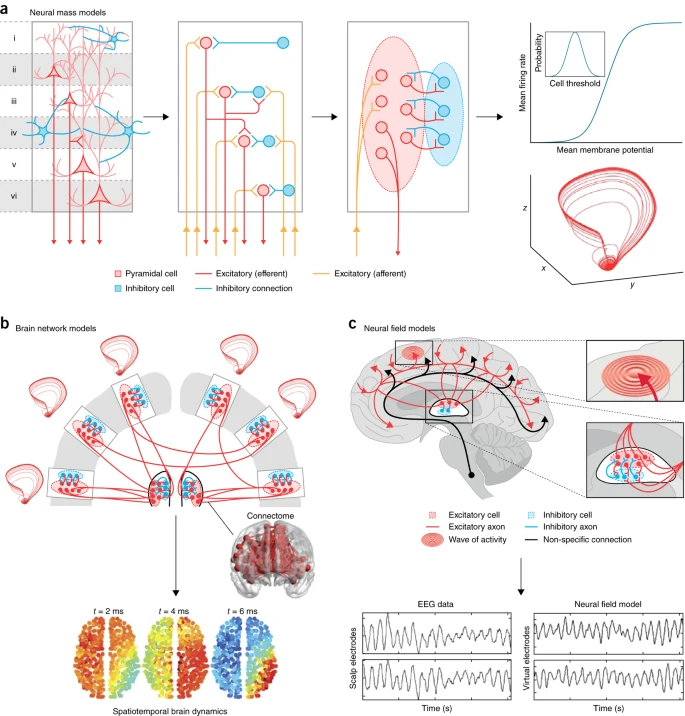
Breakspear (2017) Figure 3
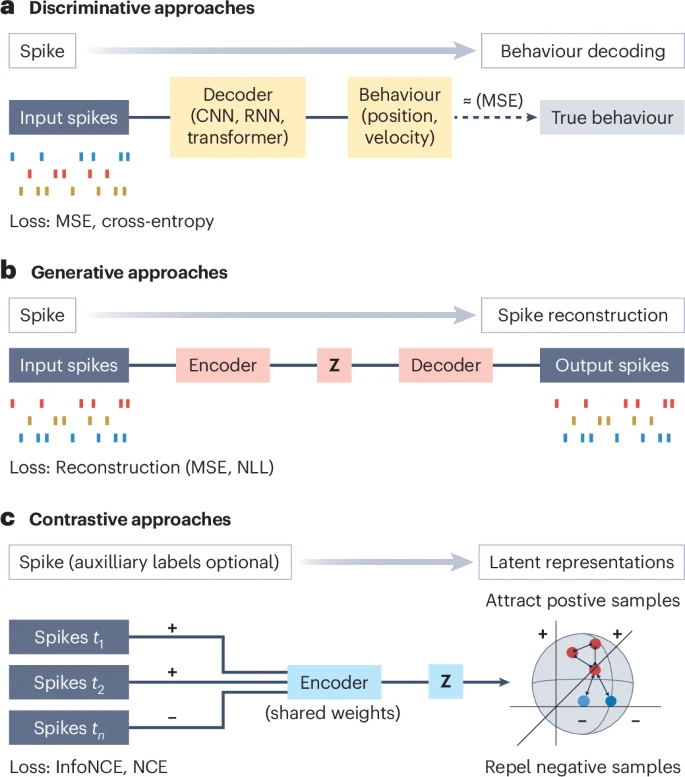
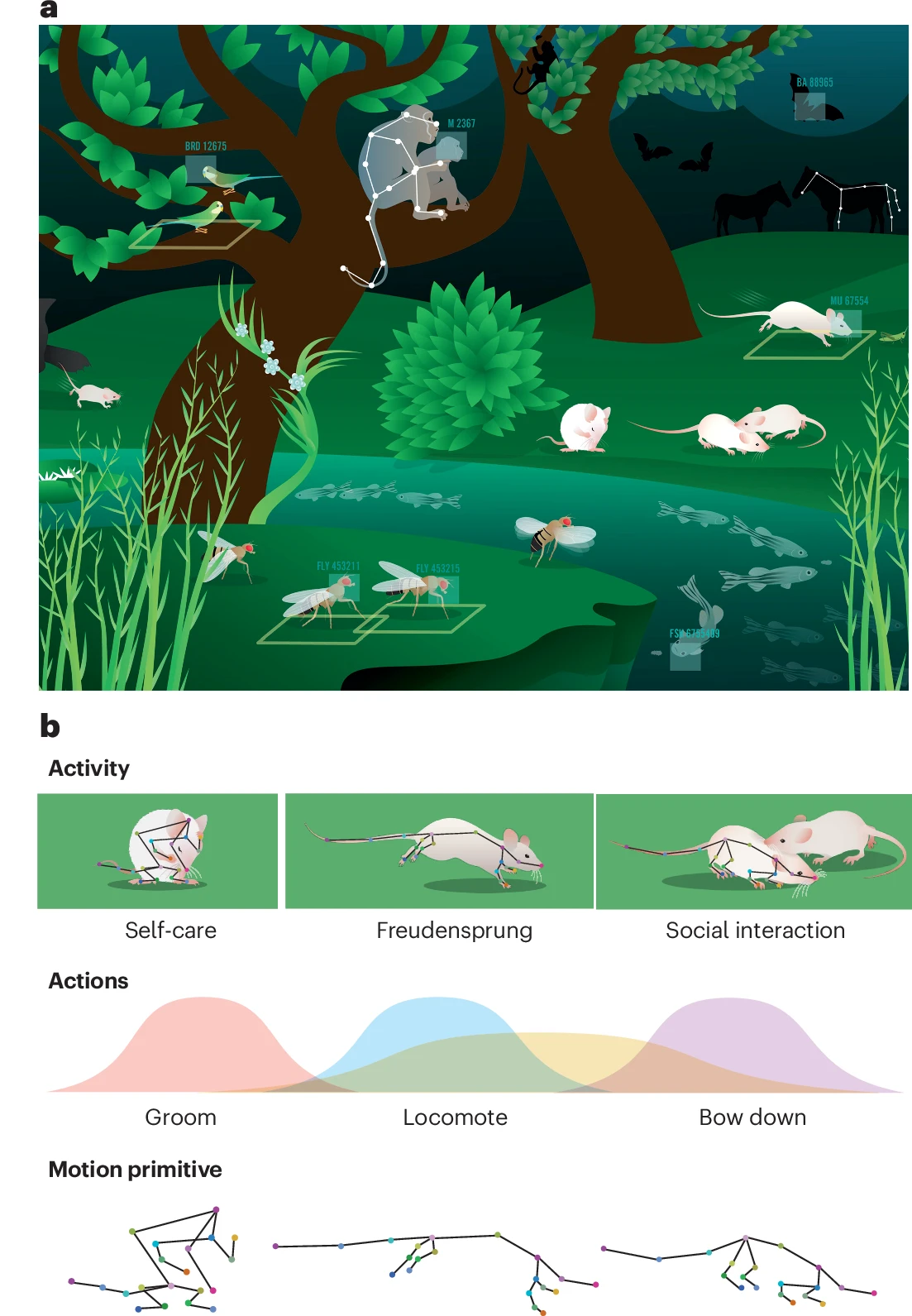
Brain/behavior dynamics via AI
Brain/gut connection
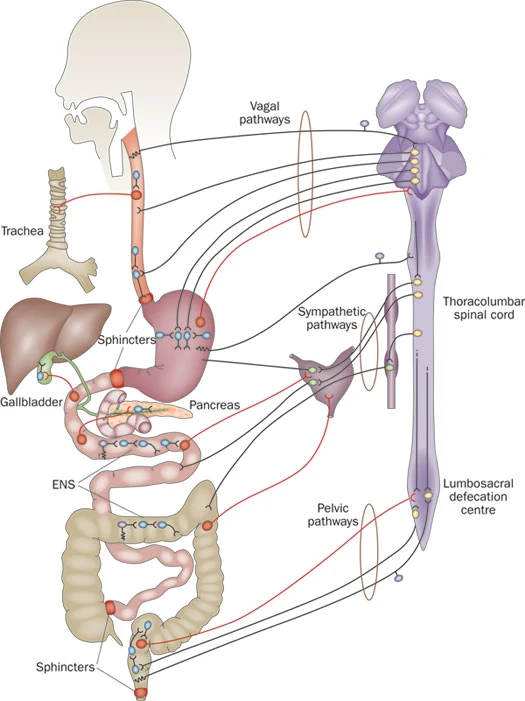
Furness (2012)
Glia
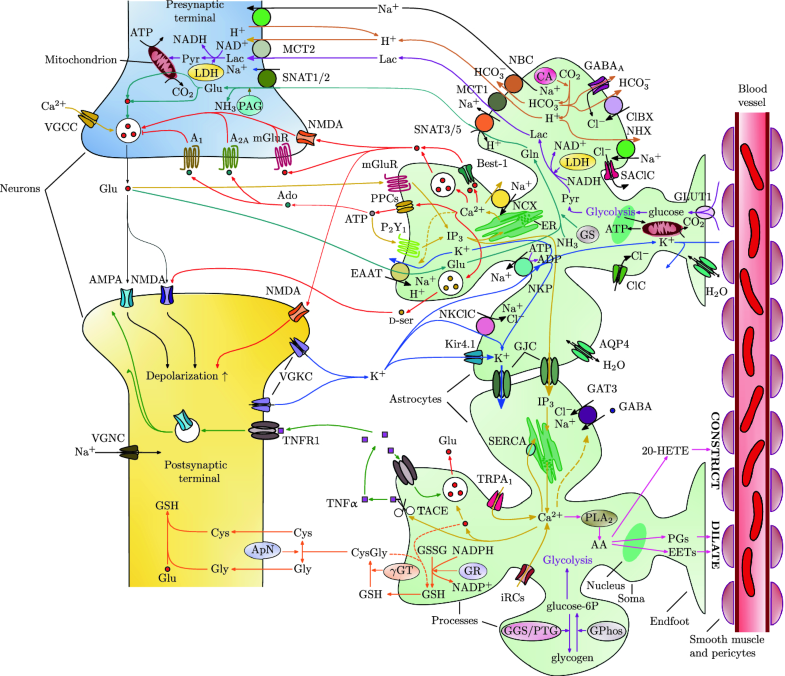
De Pittà & Berry (2019)
Disorder & disease

GBD 2019 Dementia Forecasting Collaborators (2022) Figure 3. Percentage change between 2019 and 2050 in all-age number of individuals with dementia by country.
Careers in neuroscience
Job prospects
“Employment in healthcare occupations is projected to grow 15 percent from 2019 to 2029, much faster than the average for all occupations, adding about 2.4 million new jobs. Healthcare occupations are projected to add more jobs than any of the other occupational groups. This projected growth is mainly due to an aging population, leading to greater demand for healthcare services.”
Kinds of jobs
Improve your prospects
- College is only the end of the beginning
- Acquire skills
- B.A./B.S. vs. M.S. vs. Ph.D. vs. Psy.D. vs. M.D.
- Post-bacc job experience
- Keep networking, keep in touch
- Don’t despair
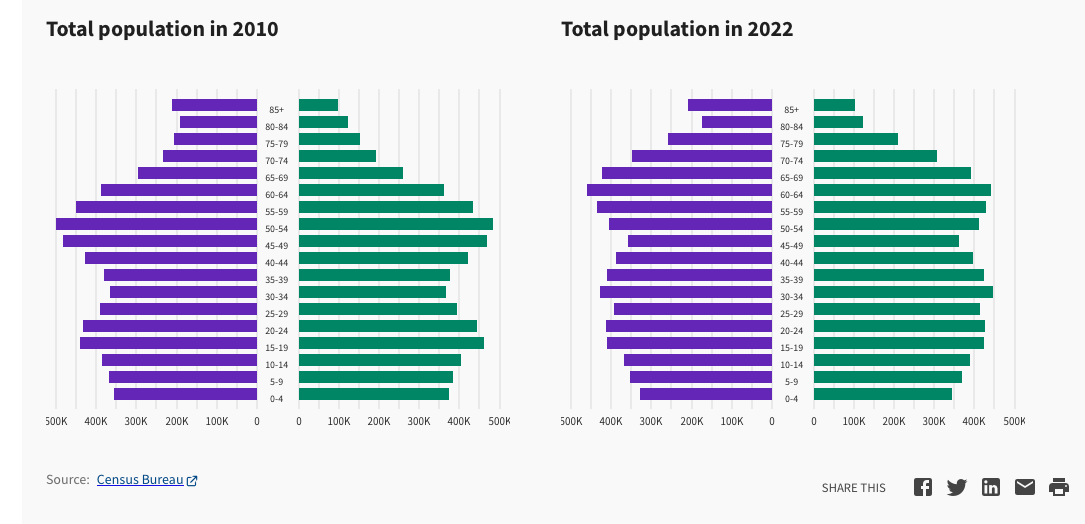
“Pennsylvania population by year, county, race, & more” (2025)
Interviewing
- Getting an interview
- Show initiative & impact
- During interview
- Come prepared – why this job? why this organization?
- Dress professionally
- Be engaged, ask questions
The Cerebral Symphony
– smalin (2011)
References

PSYCH 260.001 | © Rick Gilmore under CC BY 4.0