13. Primary auditory cortex (A1) is found in the_______________.
A. Temporal lobe
B. Frontal lobe
C. Hypothalamus
D. Basal ganglia
e. Parietal lobe
Questions 1-7 refer to Figure 1.
A. Frontal lobe.
B. Parietal lobe.
C. Occipital lobe.
D. Temporal lobe.
A. Frontal lobe.
B. Parietal lobe.
C. Occipital lobe.
D. Temporal lobe.
A. 4th ventricle.
B. Medulla oblongata.
C. Cerebellum.
D. Pons.
A. 4th ventricle.
B. Medulla oblongata.
C. Cerebellum.
D. Pons.
A. 4th ventricle.
B. Medulla oblongata.
C. Cerebellum.
D. Pons.
A. Frontal lobe.
B. Parietal lobe.
C. Occipital lobe.
D. Temporal lobe.
A. Frontal lobe.
B. Parietal lobe.
C. Occipital lobe.
D. Temporal lobe.
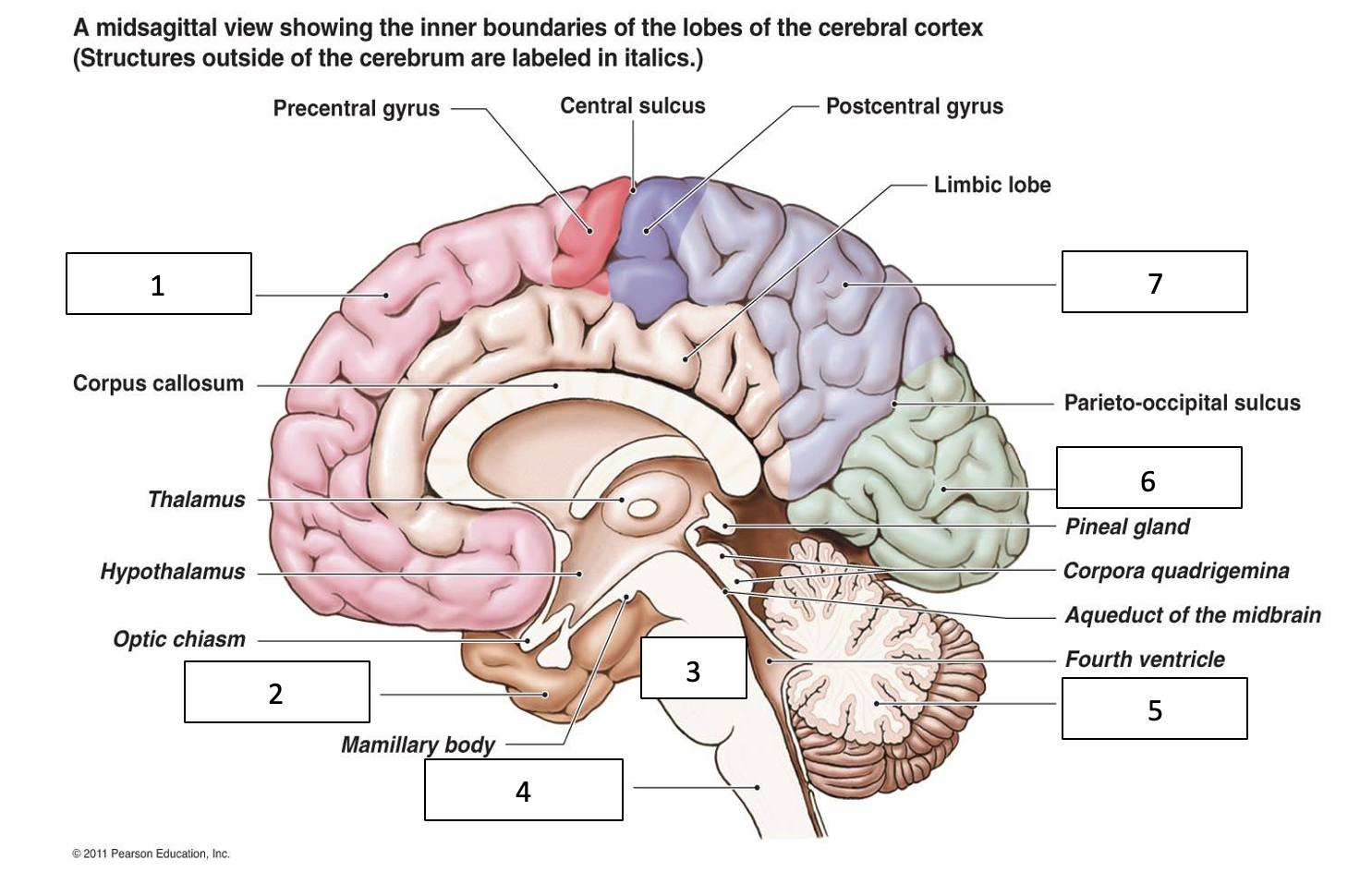
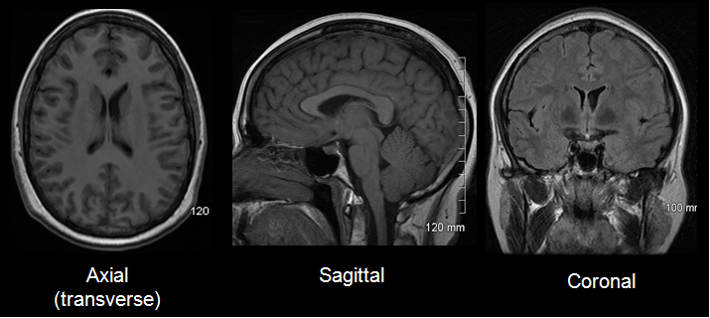
Questions 8-10 refer to the Figure 2.
A. Coronal.
B. Sagittal.
C. Axial/horizontal.
D. Dorsal.
A. Coronal.
B. Sagittal.
C. Axial/horizontal.
D. Dorsal.
A. Magnetic resonance imaging (MRI)
B. Positron Emission Tomography (PET)
C. Single unit recording
D. Computed Axial Tomography (CAT)
A. Astrocytes
B. Meninges
C. 4th ventricle
D. Circle of Willis
A. Metabolic, physical support of neurons
B. Sensory relay
C. Preparation for action
D. Memory storage and retrieval
e. CNS protection
A. Temporal lobe
B. Frontal lobe
C. Hypothalamus
D. Basal ganglia
e. Parietal lobe
A. Neurons have very short lives.
B. Neurons can extend over long distances.
C. Neurons are among the family of cells that have negative resting potentials.
D. Neurons use both electrical and chemical mechanisms to communicate.
A. Temporal lobe
B. Frontal lobe
C. Hypothalamus
D. Basal ganglia
e. Parietal lobe
A. Computed tomography (CT)
B. Functional magnetic resonance imaging (fMRI)
C. Positron Emission Tomography (PET)
D. Anterograde tract tracers
A. Basal ganglia.
B. Synaptic vesicles.
C. Cauda equina.
D. Cerebral ventricles.
A. Temporal lobe.
B. Frontal lobe.
C. Hypothalamus.
D. Basal ganglia.
e. Parietal lobe.
A. The myelin sheath.
B. The force of diffusion.
C. Action of the Na+/K+ pump (ATPase).
D. Ion flow through passive/leak channels.
A. white matter; cerebrospinal fluid (CSF).
B. gray matter; myelin.
C. central nervous system (CNS); dura mater.
D. cerebral ventricles; endothelial cells.
A. Functional MRI.
B. Electroencephalography (EEG).
C. Hemodynamic response imaging.
D. Computed Tomography (CT).
A. About 86 billion.
B. About 86 million.
C. About the same number of seconds as in the average lifetime.
D. It can’t be estimated.
A. Schwann cells.
B. Oligodendrocytes.
C. Microglia.
D. Purkinje cells.
A. Sexual behavior.
B. Metabolic, physical support of neurons.
C. Sensory relay processing.
D. Memory storage and retrieval.
e. CNS protection.
A. Sleep.
B. Metabolic, physical support of neurons.
C. Sensory relay.
D. Preparation for action.
e. Memory storage and retrieval.
A. inside; inward.
B. outside; inward.
C. inside; outward.
D. outside; outward.
A. Electroencephalograpy (EEG).
B. Multi-unit recording.
C. Transcranial magnetic stimulation.
D. Optical imaging.
A. Oligodendrocytes; MEG.
B. Schwann cells; structural MRI.
C. Astrocytes; functional MRI.
D. Microglia; structural and functional MRI.
A. Basal ganglia.
B. Lateral geniculate nucleus.
C. Tegmentum.
D. Tectum.
A. Fleeing.
B. Feeding.
C. Fighting.
D. Falling.
A. Lateral fissure.
B. Longitudinal fissure.
C. Central sulcus.
D. Inferior temporal gyrus.
A. Increase the speed of propagation.
B. Allow space in the axon for neurotransmitter release.
C. Provide structural support to the neuron.
D. Combine input from different dendrites
A. Pons.
B. Cerebral aqueduct.
C. Pineal gland.
D. Superior colliculus.
A. Na+ and Cl-.
B. K+ and A-.
C. Na+ and K+.
D. Cl- and A-.
A. voltage-gated K+ channels close.
B. voltage-gated Na+ channels close and inactivate.
C. the Na/K pump works even harder to keep the concentration balance.
D. voltage-gated Na+ channels open.
A. Axon.
B. Soma.
C. Dendrites.
D. Terminal Buttons.
A. Ligand-gated K+; close.
B. Voltage-gated Na+; close.
C. Voltage-gated Na+; open.
D. Voltage-gated K+; remain open.
A. much faster than.
B. much slower than.
C. about the same speed as.
D. slightly slower than.
A. fire again in response to an especially strong input.
B. produce an action potential that is twice the normal size.
C. open voltage-gated Ca++ channels.
D. not fire no matter the strength of the input.
A. Na+.
B. K+.
C. Cl-.
D. Organic anions (A-).
A. K+; flow out.
B. Na+; flow out.
C. K+; flow in.
D. Na+; flow in.
A. Slower falling phase of the action potential.
B. Increasing the concentration of Na+ inside the cell.
C. K+ ions would accelerate their flow to compensate.
D. Action potentials would be abolished.